Showing posts with label Montreal. Show all posts

Saturday, September 7, 2013

Satellit, Schlagzeilen lesen


While I'm anxious to move on geographically from the last few posts about Nairobi, as well as received as they have been (thanks to everyone who read and shared the last few posts). But I did want to post on a particular development near Nairobi that has been on my to-write list of this blog since very early on, and which, before I could get to it,  "has made the rounds" on the internet, as is the contemporary phrasing.

[The Atlantic Cities blog is really something of the Walmart of Architecture Blogs. It's the clearest example in this corner of the internet just how different and more corporate blogging is, in the barely half-decade since the medium of the blog became common. The once-revered Atlantic magazine, in its post-print plans, seems more intent on catching hourly page-views than the slower-paced, higher-intellect journalism that its paper version pioneered in an earlier century.]


Inspired by his visit to Silicon Valley in the United States, the home of the U.S. high-tech industry, [Information Minister] Ndemo says the project aims to attract international investors who either cannot find space in overcrowded downtown Nairobi, or who cannot find buildings that meet their standards.  
 "Kenya's $7bn Technopolis," a new development planned 60km southeast of the Kenyan capital as part of the government's "Vision 2030," seeks to pump up GDP growth to 10% per year and create hundreds of thousands of jobs, and, to hear the marketing video, transform Kenya and Africa, namely by inventing an East African Silicon Valley outside of Nairobi, thereby making Kenya a global hub for IT and call centers. Ground-breaking was delayed several times, but is apparently underway. Here is the promotion video:


Konza, and the other satellite instant cities which are springing up across Africa, manifest the vanguard financial forces that have arrived on the continent, viewing Africa as the final outpost for growth-busting capitalism, and replicate the collusional model of state-facilitated, investor-and-debt-sponsored property-development which occurs elsewhere. 
These satellite cities hope to tackle two different aspects: accommodating urbanization and creating modern cities to complement development. They also seek to embrace their respective countries' advantages. For instance, Konza City in Nairobi, Kenya is a multi-billion dollar ICT city park. The Kenyan Permanent Secretary in the Ministry of Information and Communication expects Konza City to be Africa’s home of computerization, the equivalent of Silicon Valley in California, complete with skyscrapers, business centers, international schools and hospitals. It is no secret that Nairobi aspires to be the technology hub of East Africa. 
 The main parameters of Konza and Africa's other satellite districts are the same: a vast zone on the edge of the existing metropolis, transformed in the glossy renderings of business parks and condo towers, and breezy copy, serving as both real-estate boosterism and political spin, boasting the number of jobs, the number of square miles or hectares under transformation, the population in some far-off decade, the square footage of various purposes, above all class-A office space, the number of luxury hotel rooms, the number of condos, and of course the height of the tallest, iconic building.
Satellite cities are driven by business developers and as a result are being promoted by businesses and are consequently labeled as the future of well-organized urban spaces.
It is the banality of these dual replications that is repellently fascinating: the outmoded, debt-lead financial schemes (and the corruption that pervades such machines), realized through outmoded, unsustainable design schemes (as much as they are marketed as "green").


These new cities are openly being sold as flight from the old city center, which, with its dated buildings and poor people, is deemed unsuitable for contemporary lifestyles and business. It is central Nairobi as downtown Detroit. The internet-technology-as-economic-savior trope, while no less realistic, is only slightly less out of date. Under such narratives, it may be therefore less surprising but no less outrageous,  when local Kenyan press reveals that the government has sought to specifically outlaw slums within 10-km of Konza, a sweeping radius that is experiencing rampant property speculation among the elites. The proposed high-speed rail line, non-stop from Konza to Nairobi's international airport, bypassing any actual interaction the people or economy outside of the gated city, is more evidence of the logic that governs this development.


Aesthetically, what is perhaps the most ridiculous aspect of Konza City's marketing package is also its most revealing: the random appearance of Dubai's twin Emirates towers at the town center and, even more hilariously, the presence of Montreal's Olympic Stadium as Konza's sports facility. The fiscal catastrophe of the Montreal Olympics is forgotten in favor of the futuristic icon of recreation and revenue-generation via professional sports and sport-event hosting facilities; and there is simply no higher nirvana in dreams developing-world urban growth than Dubai. While the prominent placement of copies of other cities buildings in the renderings of Konza may simply be the result of lazy draughting-by-Google-image-search, but the symbolism is inadvertently perfect.


The Konza e-city will come complete with skyscrapers, hotels, international schools, a world-class hospital, a financial district, a high-speed mass transport system and integrated infrastructure. It will put the capital city’s CBD completely in the shade as it will come with smart fully-computerised buildings, thoroughfares and other infrastructure. Coming on top of other Vision 2030 infrastructure and ICT rollouts, Konza e-city will be the jewel in the crown of a new and completely transformed Kenya.
It has the potential to create 100,000 jobs, the vast majority of them in the Business Process Outsourcing (BPO) sector. The comparison with India in the FT headline story on Kenya is indeed a suggestion that Konza e-city could well become a global call centre, placing Kenya in the big leagues of the digital world economy.  --quoted from this website


The startling, dispiriting realization at Konza and elsewhere is, that the final frontiers of human economic and community development are being radically realized as sloppy copies of the dysfunctional, and discredited spatial and financial structures of the most unsustainable cities elsewhere. If Dubai and Phoenix, Atlanta and Abu Dhabi, Dallas and Doha are seen as ecological and social catastrophes, then it is all the more dispiriting to find that dozens, perhaps hundreds of cities are rushing to be made in their image, right down to the shapes of their skylines.


Saturday, September 1, 2012

Austellung: Das Architekturmodell: Werkzeug, Fetisch, Kleine Utopie


FRANKFURT.

There are less than two weeks left to see what I think might be the most marvelous and wonderful exhibit that I've seen in several years: The Architectural Model: Tool, Fetish, Small Utopia at the Deutsches Architekturmuseum in Frankfurt. This fantastic show closes on 16 September.

Visually describing a building evinces the possibility of another building


One measure of how outstanding this show is would be to report that I left a Mediterranean beach a day early in mid-August, flew to Germany and spent the night, and the show was worth missing out on another day in the ocean and the substantial extra expense of making a dedicated trip to Frankfurt.


A mid-century German children's toy of a bank block.

A delightful series of peep-holes offered views into built and unbuilt worlds


Another demonstration of the show's merits is to show here three-dozen or so images from the exhibit, which takes up three floors of the German Architectural Museum with a plethora of astonishing, inspiring, and simply gorgeous architectural models, from children's toys to presentation models, iterative study models to vast recreations of ancient monuments, rare proposals of never-built masterpieces, peep-hole views into far-off rooms and staggeringly detailed, person-sized skyscrapers.

Conrad Roland's drawing for an exhibition hall with floating levels, 1964

Conrad Roland's Spiralhochhaus, which incredibly was conceived in 1963.

Still mesmerizing: the original model for 
Frei Otto's Medizinsche Fakultät Ulm, 1965.

Wolfgang Rathke's German Pavilion for the 
Worlds Fair in Montreal, 1964-65, mode of pink straws.


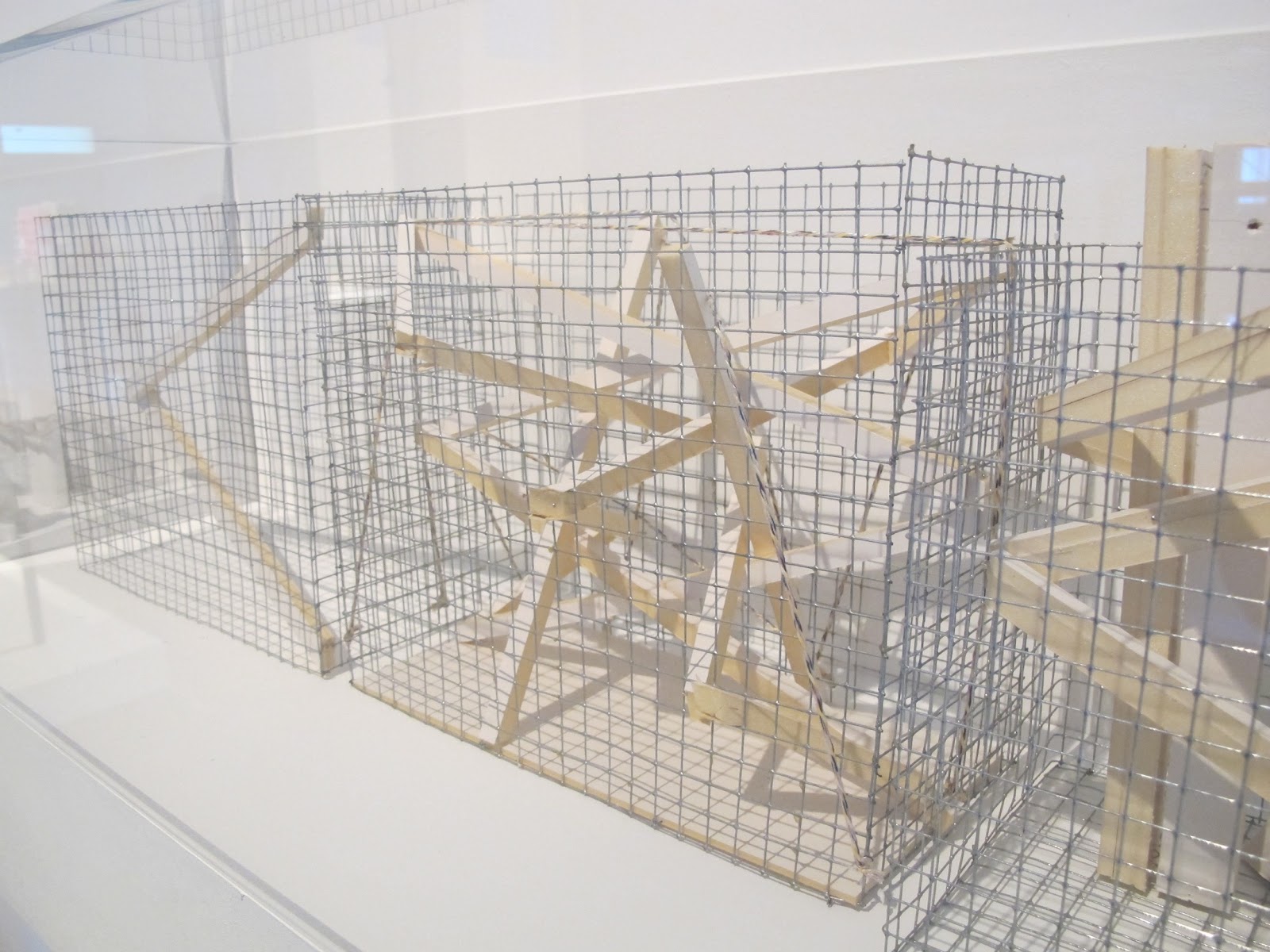
The ground floor snaps entering visitors to attention with a room-full of rare masterpieces, many of them brilliant visions which never were, interspersed with tabletops stuffed with mass and volume studies of foam and wood and preliminary designs whose forms are as adventurous and ingenious as their choice of materials such as the drinking-straw dome of the Montreal Pavilion proposal. These early-stage demonstrations continue of the top floor, such as the number of studies for Christian Kerez's unbuilt Swiss Re: Headquarters in Zürich, which reached its climax in a refrigerator-sized wooden assemblage of floors, beams, ramps, and stairs.


Christian Kerez's unbuilt Swiss Re Headquarters in Zürich.

These are just some of the hundreds of items that the exhibit has collected together, some from its own vaults, some rare gems borrowed from the archives of old masters. Together, these might roughly fall into three categories: those places which exist in the world (models of real buildings, but which give license to show an alternate reality both in terms of scale with view but also material and transparency); ancient places which exist no more, and so those models which are the best representation of what was once real; and those places which have never existed: whose closest realities are the models themselves. Highlights include the tabletop hypermetabolist landscape of Arata Isozaki's Cluster in the Air to the smaller but equally wondrous proposal by Emilio Ambasz for the Center for Applied Computer Research, an unrealized Digital-Aztec precinct on the outskirts of Mexico City.

Detail of the table-size model of Arata Isozaki's Cluster in the Air, 1962

One of the more striking models in the whole exhibit: 
Emilio Ambasz's design for the Center for Applied Computer Research, 
Mexico City,1974-75

James Stirling's Churchill College proposal, Apr-May 1959


While these never-to-be environments, found on both the ground floor and the top, would alone make for a noteworthy exhibit, the second floor is particularly awesome: At model-railroad scales (most 1:200), the visitor can play bird, or god, hovering over the humungous dioramas of ancient, medieval, and modern landscapes, many of which turned to dust centuries before the helicopter. The room opens with the quintessential rotorcraft view: a frenetic five-block slice of mid-town Manhattan, bustling with taxis at the foot of the Pan Am Building and bending around Grand Central Station.


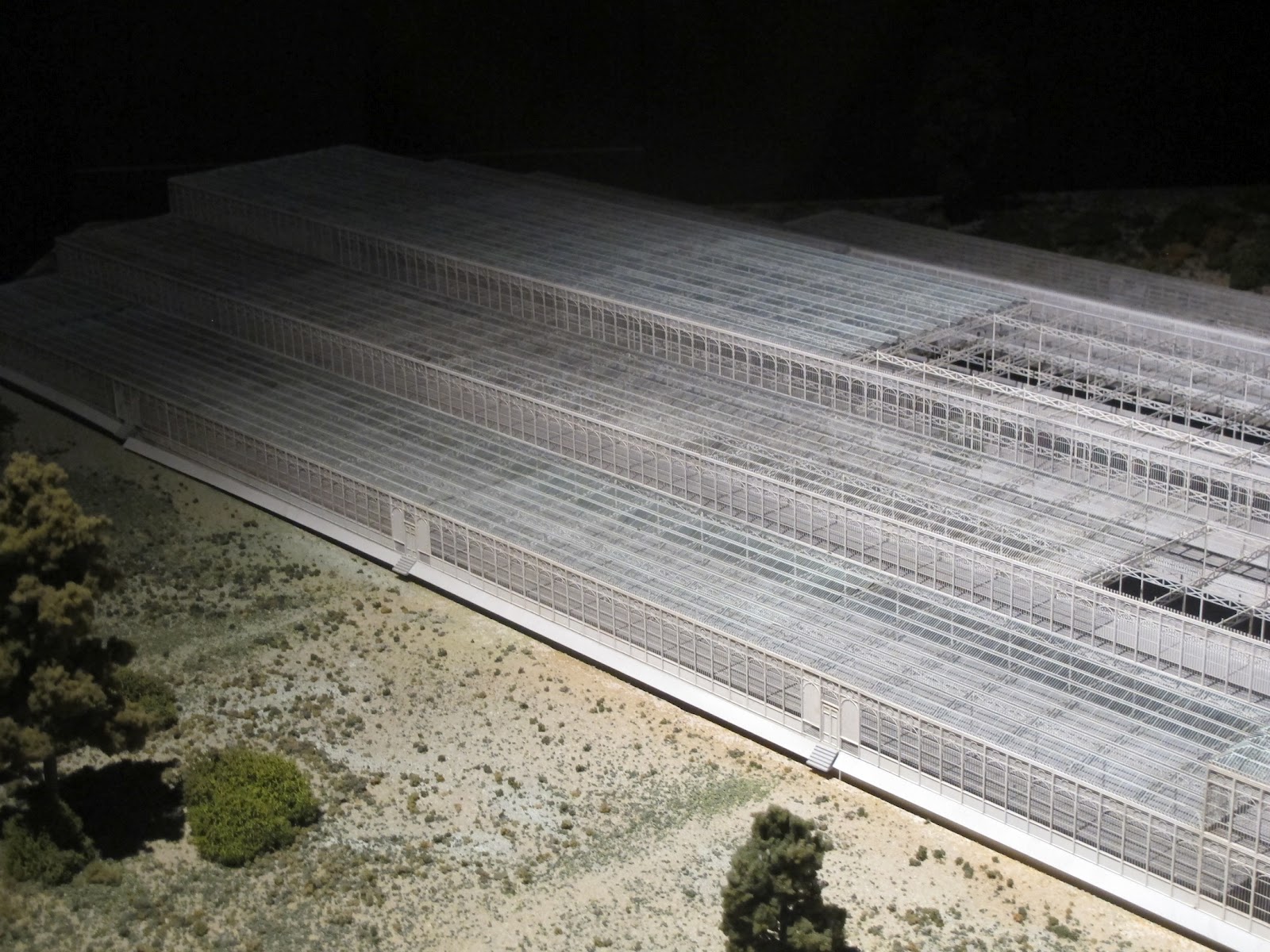
This bustle contacts with the eerie serenity of the other scenes nearby. In the whole exhibit there might be nothing so incredible a visual experience as standing alone above these landscapes of the never-more. Of all these, the lone model of the Crystal Palace presented the most jaw-dropping surprise. Even at the scale of an insect, the enormity of its enclosure is arresting, its relentless frame disappearing into the scene's dark far edge, as if it emerged from the blackness of lost history for the brief instant of this installation.


The Royal Crescent at Bath next door is similarly isolated yet, given its history, less forlorn. The other dioramas of even older times, stretching back all the way to Mycenae and Rome, Egypt and Sumeria, are not at all melancholy, but delightful and breathtaking. These might be more common in history or anthropology museums, if not toy emporiums, and certainly not in galleries of architecture, which is precisely one of the main reasons which its so refreshing to have the heart of the exhibit given over to such "popular" and non-academic displays.

The Royal Crescent, Bath.

A busy day in central Pompeii

The acropolis at Mycenae


Temple of the Pharaohs, Dêr El Bahari, Egypt.

Bruchfeldstraße Housing Development, Frankfurt-Niederrad, 1926-27

The Baroque town of Arolsen, North Hesse as it appeared in 1719


An unfortunate moment of sorts occurs as the visitor returns to the stairwell: the last diorama shows an Orinocoan settlement, a ring-clearing in the forest constructed by the indigenous Yanoama culture, one of the few moments of non-Indo-European architecture in the whole exhibit. Having seen these mono-structural villages in anthropological texts, I can attest to their impressive monumentality imbued with spiritual reasoning, which juxtaposes quite well with the square of Pompeii nearby and the Valley of Egypt across the room.

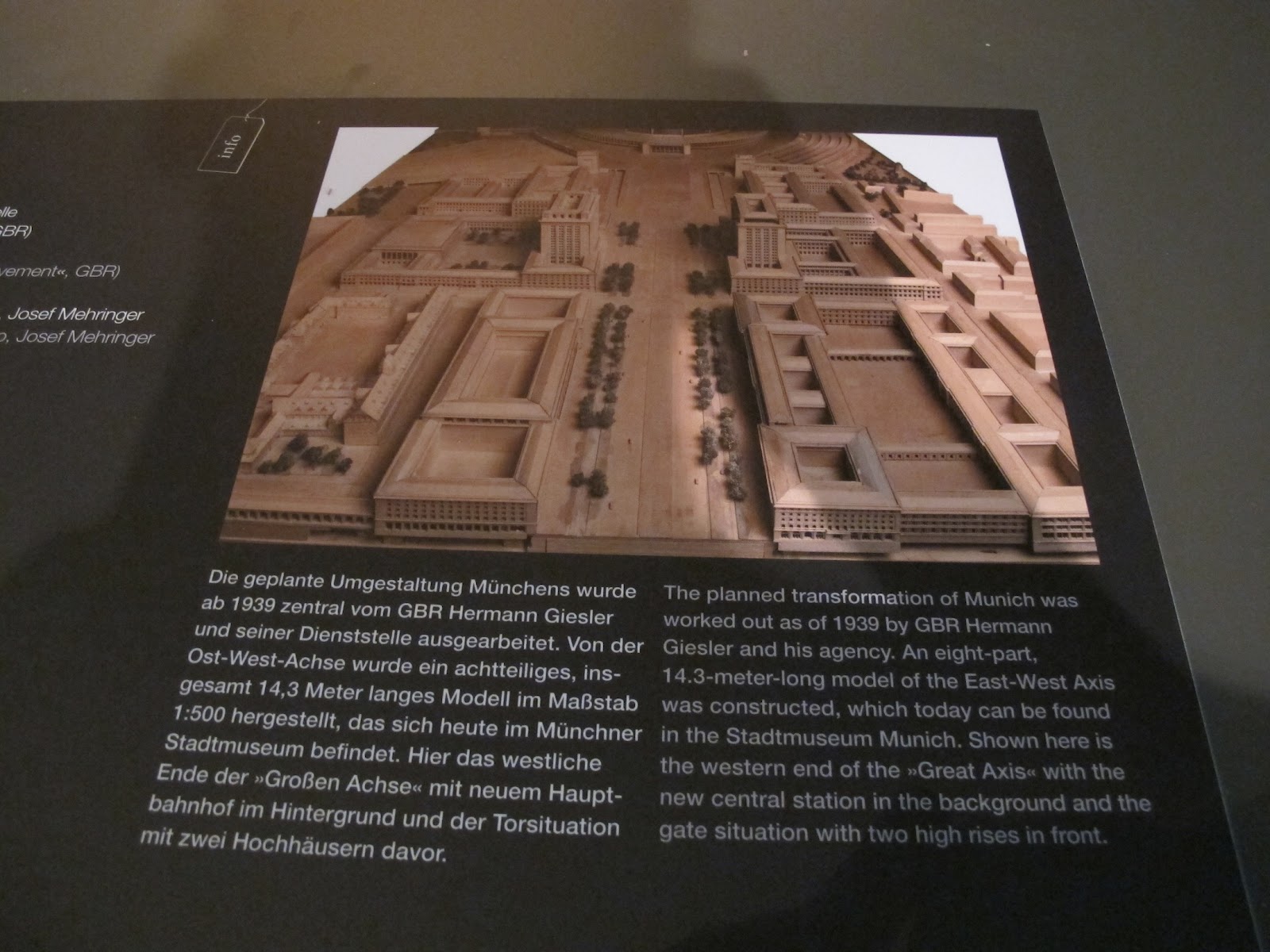
Yet the accompanying wall panel merely assigns the Yanoama the word, "primitive" which is at best a thoughtless translation, and at worst a very unenlightened classification system for a German institution to be using to categorize various peoples of the world. The more ignominious connotations of this moment are ameliorated by the floor above, which give over ample space to the importance of models in Hitler's Reich, with photos, texts, and objects from the office of Albert Speer, and the like.


The village center, a clearing the rainforest, ringed by dwellings, 
signature construction of the Yanoama, 
and how these "Indians" are described on the wall label.

A placard explaining the fascist plan for Munich, 1939.


While there is plenty of text for student or professional visitors, cueing into process, explanations of formal evolution, struggling with formal idea to execution, the constraints of construction, material, and reality, these aspects can become a bit heavy and technical, especially for those viewers who associate foam and plywood with late nights in the studio. With such a large exhibit, the great number of items to view is itself overwhelming. The exhibit might be most enjoyable in the unfamiliar moments of a micro-vista or a lilliputian skyline, understanding its translation to scale and contemplating the possibilities it suggests. These are sensations of another world.


A stunning series of small foam creations.

One particularly large display on the second floor is Foster and Partners' presentation model of the Commerzbank, one of hometown Frankfurt's most well-known skyscrapers. From this Vogelperspective, the tower still soars above the tops of heads, but the vantage point allows a view into the diminutive courtyard created by the successive arrangement of buildings of various heights and vintages, all dwarfed by the massive bank, which seems to have carved out a space in the air.


It is a simple matter of a 15-minute walk from the museum, crossing the Main on foot to see this architectural moment in person. While the model's white foam pieces come alive in brick, stone and glass in the sunlight, the dynamic might of the tower's mass against the block and older offices is somehow lessened from the street. Yet this arrangement of masses is more familiar now. Having looked down, it is better understood. For a moment, you flew above it, and could hold a tower in your hand. But you are no longer flying. The imaginary helicopter has landed back on earth, in reality.

Tuesday, January 11, 2011

Two Terrific Shows On at the CCA


MONTREAL, AMSTERDAM, LIBERIA, BRAZZAVILLE, etc.

For anyone who might be traveling to Montreal in the next three months, I highly recommend the Canadian Centre for Architecture's two current shows, which are both quite excellent.

Both take on topics of fairly large scope. Error 404: The Object Is Not Online, is the smaller of the two exhibits, in the Octagonal Gallery until February. It sets out to remind those of us who spend way too many hours on the internet about the important and useful tools, besides bright screens, that invite architectural exploration and understanding. In allowing an encounter with drawings by Cedric Price and Aldo Rossi, a spike of John Hejduk's The House of the Suicide, and an interaction with a Microstation project by Gregg Lynn, the very real limitations of the digital are evinced.

Play with woodmen blocks, not Rhino. ©2010 Bauzeitgeist


Secondly, from now until March the CCA has put on an exhibit of extraordinary accomplishment called Journeys, an eclectic tour exploring a number of disparate topics relating to the movement of goods, ideas and architecture across the world. This theme is extremely broad, and each individual display is only in the broad terms of the exhibit related to any other.
In its curatorial execution the Centre has achieved an masterful feat of not only showing how widely such instances occur, but each thoughtful example illuminates a curious and entertaining corner of the history of the built environment and how it evinces change and translation. To quote the accompanying volume, "it examines the consequences and results of these displacements." I usually go for the catalog when I visit an exhibit, but in this case there is an especially well-written volume published by ACTAR.


The exhibits has many fine topics worth discussing, but I will limit to a few gems. Predictably, I was particularly mesmerized by the headline juxtaposition involving Max Belcher's photographs of settler architecture in Liberia, the first time I had seen them off the printed page, (which I talk about to somewhat exhaustive degree over at Moved2Monrovia and won't get into here). There were several other incredible displays nearby, including a video filmed in Brazzaville about the Chinese construction of faux-Italian luxury villas for government ministers, a story told by Serge Michel, the author of the excellent book China Safari.

Bijlmermeer. ©2010 Bauzeitgeist

Another highlight is half of a gallery given over to a huge display of videos, drawings and models for Amsterdam's Bijlmermeer development of the 1970s. Somewhat inevitably, the viewer is made taken down the cul-de-sac of Rem Koolhaas's dormant 1986 re-development plan, but the main emphasis of the story is how the unforeseen uses and tensions of immigrant residents shattered the modernist dream of what was to be a new and pristine future.

Image courtesy Affordable Housing Institute

The exhibit is replete with wonderfully optimistic vintage promotional films and newsreels foretelling the construction of new towers of fresh air and light, and later footage of the impact of Surinamese independence and immigration of Gastarbeiter families from abroad, who were located in this isolated pocket on the city's periphery, creating a segregated enclave, and setting up the area for failure.

Although developed in a later decade than many of social housing experiments, Biljmer's story so closely echoes the tormented sagas of American housing projects. Many of Bijmer's buildings were eventually torn down in the 1980s and 1990s, but it is also tempting to find a Pruitt-Igoe moment of sorrowful destruction in the awful crash of El Al cargo flight into the Biljmer blocks in 1992--this conflagration is completely unmentioned in the CCA exhibit.