Showing posts with label Pruitt-Igoe. Show all posts

Tuesday, April 5, 2011

Volkshöfe


The Cabrini-Green Homes, Chicago. ©Google.
Note that some of the razed buildings are still outlined on the street map.

CHICAGO and LONDON.

Last week, the final tower block of the Cabrini-Green Houses, a massive public housing campus on the near north side of Chicago, was demolished. This denouement had been announced in the press several months previously, and indeed the complex had been systematically evacuated and razed over a period of many years. But the wrecking balls of the last several days mark the final nail in the coffin for the famously-troubled housing estate, which for years was a war zone of gang violence and drug abuse.

Just about the only commemoration of this Pruitt-Igoe moment was a local artist's lighting installation, featuring flickering bursts of light appearing like a final battle of automatic weapons fire was taking place in the vacant concrete shell of a building where guns were in abundance.

Image ©Clark Mizono courtesy Next American City.

This is a very different fate than has been enjoyed by a pair of council towers in London, the Balfron in East London and the Trellick Tower, the signature backdrop of up-market Notting Hill, a publicly-subsidized residential block that experienced equally-diabolical lawlessness and whose name today is about as equally well-known in the popular culture of its home country.


Trellick Tower ©2006 Bauzeitgeist

The Trellik underwent a sustained period of pervasive inhumanity that is on the one hand horrifying and the other so nearly identical to the worst reports out of Cabrini-Green as to introduce the possibility of conflated urban mythology-- especially as the vague anecdotes of the Trellik's Wikipedia article are un-cited-- although it seems to be verifiable that girls were raped in the circulation spaces of both structures at some point, and that both Trellick and Cabrini-Green were contemporaneously metonyms for public-housing hells.

Cabrini-Green via the Tumblr 41'52'55''N 87'37'40''W

And yet in the same years that Cabrini-Green has been systematically evacuated and erased, Trellick has become the undisputed domicile of choice for contemporary ironic hipsterism. Its place as the mighty temple of retro-fetishized gentrification is evinced by the presence of a vintage clothing boutique at the base of the building, called: RELLIK, its storefront looking as if the original tower signage lost its first letter over the course of the decades.

Trellick-printed consumer products: a plate and skirt
by People Always Need Plates, sold at the London Transport Museum.

Beyond its immediate surroundings, Trellick is celebrated in fancy designer flatware sold in art museum gift shops, while its older sister on the other side of the British capital, the near-identically formed Balfron, is famed in music videos and apocalyptic feature films, and more recently, celebrated by professional photographers.

Balfron Tower by artist Simon Terrill

I wonder what would have made the difference to have had Cabrini-Green gentrified rather than abandoned. The estate possesses both the most potent name recognition and accompanying hip-hop lore of any public housing the US, which today's hipsters consumed as suburban teens in previous decades. Add to this the oft-noted, curious circumstance of its enviable location, cheek-by-jowl with the Old Town and Gold Coast, the most valuable real-estate in the midwestern United States, would seem to provide a ready market of affluent ironic gentrifiers, ready to sign a lease to set up house like they were squatting in a rap video, enjoying the proximity of the EL train to their office jobs in the Loop.

Cabrini-Green in mid-center, seen from a condominium tower on the shore of Lake Michigan
(a newly-opened condo tower is at right foreground). ©2007 Bauzeitgeist.

There are all sorts of reasons for the divergent fates of the Chicago houses and the London towers, but not least of them is the simple fact that the Trellick and Balfour are fantastical brutalist exuberances, whereas the Cabrini-Green towers are dull, anonymous blocks. Goldfinger's unique, whimsical form of thick concrete make his works prime for design-geek admiration, and a large part of the appeal of the London blocks over Cabrini-Green is surely the appeal of the iconic forms of the former compared to the dank, banal slabs of the Chicago campus, which will never been called masterpieces. Nonetheless, this ugliness might have been embraced as a further support the urban gentrification fantasy's irony.
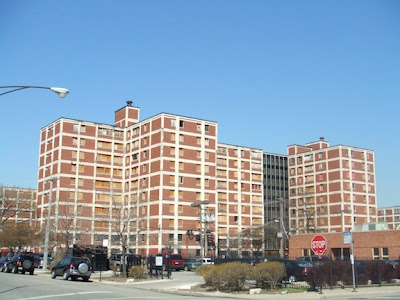
©Bauzeitgeist 2007.

While a longer essay might explore the social and political factors which unquestionably influenced this divergence as much as any design issue, such as American racism and the Thatcherite ownership agenda, it might be useful instead, in focusing on the aesthetic and cultural juxtaposition, to include a third series of public housing constructions: the work of Bertrand Goldberg for the Chicago Housing Authority.

Goldberg most famously designed the iconic Marina City, a self-contained development on the banks of the Chicago River. On the South Side of the city, Goldberg was contracted by the CHA to design the Raymond Hilliard Homes, featuring Goldberg's signature ovoid fenestration and footprint, were designed to instill pride of place in the low-income and elderly residents. Never featuring the crumbling decay or the chaotic villainy of the Cabrini-Green Homes, the RHH enjoyed several uneventful decades of occupation.

Image from the Bertrand Goldberg Archive.

In 2006, at the height of the real estate boom, under a program to rehabilitate the CHA's physical assets, the RHH underwent a US$100m renovation into market-rate housing.

Likewise, the 70-acre expanse of the former Cabrini-Green area has for nearly a decade been slowly converted from a field of towers to a much low-rise mixture of private, market-rate condominiums and town-homes, and suburban-style cul-de-sac'ed subsidized housing, called North Town Village-- a name unlikely to roll off the tongue of hip-hop performers, instill fear in suburban teens, or generally enter the American mythology.

Tuesday, January 11, 2011

Two Terrific Shows On at the CCA


MONTREAL, AMSTERDAM, LIBERIA, BRAZZAVILLE, etc.

For anyone who might be traveling to Montreal in the next three months, I highly recommend the Canadian Centre for Architecture's two current shows, which are both quite excellent.

Both take on topics of fairly large scope. Error 404: The Object Is Not Online, is the smaller of the two exhibits, in the Octagonal Gallery until February. It sets out to remind those of us who spend way too many hours on the internet about the important and useful tools, besides bright screens, that invite architectural exploration and understanding. In allowing an encounter with drawings by Cedric Price and Aldo Rossi, a spike of John Hejduk's The House of the Suicide, and an interaction with a Microstation project by Gregg Lynn, the very real limitations of the digital are evinced.

Play with woodmen blocks, not Rhino. ©2010 Bauzeitgeist


Secondly, from now until March the CCA has put on an exhibit of extraordinary accomplishment called Journeys, an eclectic tour exploring a number of disparate topics relating to the movement of goods, ideas and architecture across the world. This theme is extremely broad, and each individual display is only in the broad terms of the exhibit related to any other.
In its curatorial execution the Centre has achieved an masterful feat of not only showing how widely such instances occur, but each thoughtful example illuminates a curious and entertaining corner of the history of the built environment and how it evinces change and translation. To quote the accompanying volume, "it examines the consequences and results of these displacements." I usually go for the catalog when I visit an exhibit, but in this case there is an especially well-written volume published by ACTAR.


The exhibits has many fine topics worth discussing, but I will limit to a few gems. Predictably, I was particularly mesmerized by the headline juxtaposition involving Max Belcher's photographs of settler architecture in Liberia, the first time I had seen them off the printed page, (which I talk about to somewhat exhaustive degree over at Moved2Monrovia and won't get into here). There were several other incredible displays nearby, including a video filmed in Brazzaville about the Chinese construction of faux-Italian luxury villas for government ministers, a story told by Serge Michel, the author of the excellent book China Safari.

Bijlmermeer. ©2010 Bauzeitgeist

Another highlight is half of a gallery given over to a huge display of videos, drawings and models for Amsterdam's Bijlmermeer development of the 1970s. Somewhat inevitably, the viewer is made taken down the cul-de-sac of Rem Koolhaas's dormant 1986 re-development plan, but the main emphasis of the story is how the unforeseen uses and tensions of immigrant residents shattered the modernist dream of what was to be a new and pristine future.

Image courtesy Affordable Housing Institute

The exhibit is replete with wonderfully optimistic vintage promotional films and newsreels foretelling the construction of new towers of fresh air and light, and later footage of the impact of Surinamese independence and immigration of Gastarbeiter families from abroad, who were located in this isolated pocket on the city's periphery, creating a segregated enclave, and setting up the area for failure.

Although developed in a later decade than many of social housing experiments, Biljmer's story so closely echoes the tormented sagas of American housing projects. Many of Bijmer's buildings were eventually torn down in the 1980s and 1990s, but it is also tempting to find a Pruitt-Igoe moment of sorrowful destruction in the awful crash of El Al cargo flight into the Biljmer blocks in 1992--this conflagration is completely unmentioned in the CCA exhibit.


Books of the Decade: The Pan Am Building


It had occurred to me earlier this month that an entire decade had come to a close. While I have read too many end-of-year posts (some of them excellent) to think adding one of my own would be worth anyone's time, I had started to develop a Top Ten Books of the Decade List, that is, the ten best books published since 2000, that have had the greatest influence on me or gave me the greatest enjoyment. But Instead of putting together a list in one post, or implying some sort of ranking, I've decided to produce an entry on each book, and therefore have more space to discuss each.
image courtesy MIT Press

One of my favorite books published since 2000 is The Pan Am Building and the Shattering of the Modernist Dream, by Meredith Clausen, who teaches architecture at the University of Washington.

Aside from having an awesome title, this 2003 volume, uniquely both a thoroughly-researched history, and in its proportions a bit akin to a image-rich coffee table book, is an important and very relevant architectural saga. Among architectural books, it is less common to encounter a cautionary tale of discredit than a glitzy promotional publication, and for this reason generally, as well as so many of the particular details of this case study, it is an excellent work and one of the best books I've read in the last several years.
The Pan Am, The Monster That Ate Park Avenue, was the largest commercial office building in the world when it was completed (rather than a more easily-understandable and publicly-embraced title such as tallest building), a triumph of square footage over civic virtue, of private interests over public welfare. Universally derided as a failure of architecture, and voted by the readers of New York Magazine in 1987 as New York's most hated building, it symbolizes so much that was squandered to hubris in its time, a challenge still relevant today.

Involving some of the most prominent and legendary individuals of mid-century American architecture. On the design side, the story involves two deans of modernist aesthetic and theory, Walter Gropius and Pietro Belluschi, whose employment as genuis-visionaries to the project can be seen as an early use of architectural Star-power in the marketing of corporate real estate.

In reaction stood two glass-ceiling-shattering leaders of a great era of architectural criticism: Ada Louise Huxtable and Jane Jacobs. Surrounding these well-known names are some of the major political and corporate forces of post-war New York, and the work was crowned with the symbol of America's global corporate might, Pan Am. The airline's association was not just a nameplate, as the building was realized with a heliport at its crown, with fantastically-bulbuous aerotaxis roaring off the brow the building, whisking businessmen to Pan Am's global air routes at Idlewild. The building managed to even offend the auditory sense.


In the chapters dealing with this cacophony of criticism its interesting to read concerns over city-center density prominent in the debate. Nowadays its less common to encounter fears of an American city becoming too crowded-- this in an of itself foretells the paradigm shift, as American cities were already beginning to thin out by the 1960s. The aesthetic debate did not so much address insipid material or program, but rather the insidious malevolence of shadow. The lack of light and air are repeatedly mourned, and in these chapters the early stages of historic preservation can be seen.


An important incident late in the building's tragic tale evinces how the modernist dream was not only blacked out in the cold, stifling shadows of its monuments, but were truly shattered. In the 1977 accident of a commuter helicopter landing on the roof, the torquing of helicopter blades killed five passengers waiting on the landing platform, and ricocheted off the building to kill and maim individuals on the sidewalk below. That a futuristic transport machine connecting to behemoth office block actually slashed a lone pedestrian to death is not only horrifying but an epigrammatic episode of modernism's vicissitudes. Perhaps this was a Pruitt-Igoe moment for commercial real-estate?

image courtesy Life

This was of course, not the first and not the last in a series of aviation disasters involving Manhattan Skyscrapers, and beyond seemingly presaging the death of Pan Am, one of America's proudest commercial symbols, in one particular aspect the impact of that falling debris continues to reverberate: we are a world largely without commuter helicopter services. over 30 years later, with something of a "where's my space age" lament that rotorcraft have yet to progress further into the realm of municipal mass transit.