Showing posts with label Pan Am Building. Show all posts

Monday, March 10, 2014

Jimmy Fallon's Skyline

A few weeks ago, the Tonight Show starring Jimmy Fallon made its big debut. I don't watch a lot of television, much less late at night, but think Jimmy Fallon is a really clever, energetic, creative entertainer, and nowadays its easy to watch a handful of clips on YouTube and feel like you're at least partly aware of what is going on.


The Tonight Show has an all-new set, which follows the standard desk-and-couches-on-a-soundstage format. What I immediately noticed was the backdrop, which is made up of a panoramic photo image of Mahattan, but in front of it what was especially notable is a collection of more than three dozen wood building models.


The buildings are arrayed randomly in the display—their arrangement doesn't correspond to their true relationships, and it doesn't appear as though the models are to scale with one another. This makes identification a bit difficult, and I am also not certain that all the models have been detailed with equal faith to their original appearance. There is a small, laser-cut Pan Am Building, visible second from left above; it is less-detailed and more diminutive than the finely detailed McKim frontage of the NYP Library and the Chrysler Building just over Jimmy's left shoulder, which seem to use a variety of materials and might even be from a model kit.

During Justin Timberlake's appearance, its easy to spot the AT&T Building, directly behind the microphone, 
with what might be the Daily News Building behind. 
The Woolworth Building is easy to spot behind Timberlake at far left. 
I am tempted to suggest that the Building to its right, behind Timberlake's head, 


is the Helmsley Park Lane Hotel on Central Park South.

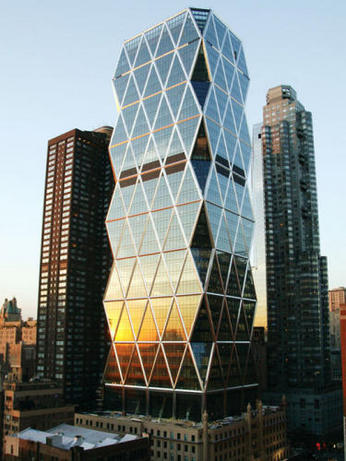
There are some interesting choices here, besides the world-famous landmarks such as old as the Woolworth and Chrysler Buildings and as new as the One World Trade Center, there are secondary icons like Johnson's AT&T Building, Stubbin's Citicorp Center and Johnson’s Lipstick building. Some other notable inclusions include Piano’s New York Times Building, just behind Jimmy, and at the far left, normally not visible but clearly shown in these scenes of U2 and Will Smith, Foster’s Hearst Tower. Other recognizable but far less identifiable towers include post-modern art deco Trump Riverside, the bland corporate mid-rise of 4 World Financial Center, and the hipster Maritime Hotel.

The Chrysler Building shines behind Fallon's right shoulder, with the Lipstick Building in front. 
Behind Fallon's left shoulder, in the shadows at far right, is Piano's New York Times HQ, 
with a twin tower from Trump Riverside in front. 

There is a foreground layer of low-rise landmarks, too, including the Arch in Washington Square Park, the Pier 17 at the South Street Seaport, the Guggenheim, New York Public Library, the New York Stock Exchange, and the tripartite arrangement of Lincoln Center.


During U2's performance, 1 World Trade Center and the Hearst Tower are clearly seen behind the Edge. 

But still, I was only confident in labelled a little more than half of them: is that the Daily News Building just over Jimmy's right shoulder? Is that big, French-Empire Style manse behind the guests, with its green-copper roof, supposed to be the legendary Dakota apartments? Others, like the sample Tribeca warehouse and the prototypical SoHo cast iron façade, would be laborious to pinpoint to a specific real-life building. For all I know, a third of the models are just made-up, and not based on real buildings. I certainly suspect that is the case, even with the larger models such as those between the Chrysler and Citicorp to Fallon's left, at the far right of the background.

Kristen Wiig impersonating Jason Styles. Lincoln Center is clearly visible at left, 
with what appears to be a tiny Guggenheim Museum in front. 

Behind Kristen Wiig, on her right: A SoHo building, Pier 17, the Dakota? 
On her left: a TriBeCa warehouse, Lincoln Center at lower right, and the Maritime Hotel behind.

When Jerry Seinfeld visited the new show, while praising the show, he turned around admired the elaborate background:

”I love the set. I love the rich kid NY chess set. This is the upper east side kid's chess set. It's beautiful, but I would move the chrysler building to king 4...”


Here is a quick diagram I made of the display, with whatever buildings I could identify. Suggestions for changes or additions are welcome in the comments section: 


Saturday, October 12, 2013

Victor Victoriana

Above: Portland House & Westminster Cathedral over Green Park. ©2013 Bauzeitgeist. 
Below ©Google.
LONDON.

The increasing hideousness of the City of London's skyline is frequently decried just for the ugliness of the new architecture itself, but the loss of the capital's historic vistas, mentioned in terms of the now-carefully-studied "view corridors"–of St. Paul's in particular but also the Houses of Parliament in Westminster. The new glass-and-steel financial towers block the distant appearance of the cathedral's dome or the heroic Big Ben and Victoria Tower of Parliament. Paradoxically, the concern over these sight lines seem to overshadow the demerits of the new skyscrapers themselves, which it seems can be hideous as long as they are a referential distance  from London's more ancient landmarks.

A counterargument to this is that it ignores all the terrible office buildings that have been rising in prominent locations across London for decades. As mentioned in the last post, this is a different issue in leafier west London, away from the narrow jagged alleys of the medieval City. These more residential areas have had fewer demands for tall buildings, more restrictions on new construction, and are home to two of the capital's largest parks, the perimeters of which space out a handful of tall towers, most of which were realized decades ago.

Portland House over the top of Green Park. ©2003, 2013 Bauzeitgeist.

The West London district that most closely resembles the City of London is Victoria. Before ever visiting Britain, I heard the name, and assumed that only one of London's nicest areas would be named after a queen. But this is not the case. The grandeur evoked by its moniker seems grossly misapplied to the tangle of busy, dirty streets, in misnomers like the busy Buckingham Palace Road.

171 Victoria Street, HQ of John Lewis.

Victoria is sort of the District of Columbia of London, with a heavy dose of Madison Square Garden at its center. Home to a large portion of the British government, it features several busy thoroughfares lined with dull office blocks, home to a lot of the back-office bureaucracy and the UK lobbying industry. This sad zone stretches between Parliament and Buckingham Palace, forming a triangle with its namesake, the enormous Victoria Railway Station, an ugly procession of dusty sheds, which somehow managed to become even more revolting by a partial conversion to a low-ceilinged shopping mall, which itself continues on to a massive bus terminal, its steel frames covered in several decades worth of dust and pigeon poop. An analytical post could be dedicated to just this low-lying carbuncle itself, oozing across the southern threshold of one of the world's most expensive neighborhoods, minutes from bedrooms which go for a million-and-a-half pounds each, and a 15-minute walk from one of the most famous houses on the planet.

Victoria Coach Station, Buckingham Palace Road. ©2006 Bauzeitgeist.

The other side of this district hosts a handful of half-tall, boring office towers. What is most shocking to a visitor's sensibility is that this cluster of buildings, a sort of office park right in the center of Westminster, is within a few blocks of one of the greatest monuments of modern monarchical mythology, Buckingham Palace. The group of dull blocks spoil the background of the pristine royal fantasy, Green Park gets the backdrop of a suburban office park.


The most noticeable building to rise over the treetops of Green Park is Portland House, a building so bland it is hard to pick it out of a lineup. As if the area between the regal Mall and the train station wasn't turning out badly enough, somehow a shortened Pan Am building (with nearly identical octagon shape and depressing ground floor porticos) dropped down like a lead curtain; the Monster that ate the Green Park. In a classic Maupassantian moment, the property company boasts of the tower's "stunning views" while Portland House prominently detracts so many others from elsewhere in the city.

Portland House, visible with Big Ben, the Shard, Victoria Tower, One Canada Water, and the Westminster Cathedral.
©2013 Bauzeitgeist.

In a quintessential New-Ruins-of-Great-Britain move, the forecourt was done over ten years ago as a glass-domed mall, so the cubicles full of bureaucrats could have their basement gym and food court and shopping. The fourth floor is leased out to the Kazakh resource group that is currently taking over disgraced commodities firm ENRC.

The front of Buckingham Palace, with Cardinal Place and Victoria in the background. 
©2013 Bauzeitgeist.

If anything could ruin the scene from Buckingham Palace more than this, it would have to be the erstwhile Home Office, now the Ministry of Justice, which today, like all soulless structures, is most commonly referred to only by its street address, 102 Petty France. Perhaps only in England could such an enormous and over-bearing structure somehow end up referred by such a cute little name as Petty France, as if the façade's fenestration referenced a particular style of lace doily rather than a Brutalist blockbuster.
This is another realization of Sir Basil Spence, designer of the Household Calvary Barracks covered in the last post. Celebrated another of the most hated buildings in Britain, it caused a Lord to once remark that Spence ruined two London parks with his monstrosities: the Household Calvary wrecked the bucolic idyll of Hyde Park, while the Home Office destroyed the serenity of Green Park (Portland Place aside).
Whether to instills admiration, or admonishment, its mass make one of the most compelling attractions of the whole quarter, another helmeted, cement-paneled soldier rudely wrecking a precious royal vista. Its block-long body features  a double-row of giant goggled bay window galleries staring wide-eyed at the street, monitoring. The higher stacks feature more repetitive windows, its bulbous noggin blotting out even more light. This bureaucratic fortress remarkably resembles the J. Edgar Hoover Building, the FBI Headquarters in Washington, DC, and is therefore all the more fitting that the building's apparent nickname was Lubyanka, after the enormous palace headquarters of the KGB in Moscow.

(4) Previous photos of 102 Petty France ©2013 Bauzeitgeist.

Its tempting to conclude that this repulsiveness was somehow intentional, that the bloated absurdity of this building, while a fitting home to a bloated agency of bureaucracy, was in fact impugning the ridiculously over-large imperial manor sitting just a short walk away–that the narrow lane of Petty France was the closest that Spence could get to stage his protest.


Thursday, September 27, 2012

Munchin' in München

MUNICH.


Just a few days after departing Frankfurt, still in an inspired daze from the experiential overload the Deutsches Architekturmuseum's exhibit on building models, I was walking the streets of Munich, but still imagining miniature landscapes of ancient Pompeii or the visionary fantasy of Isozaki's metabolist metropolis.


One of the best models, as I mentioned in the post about the exhibit, was the square slice of mid-town Manhattan, bustling with traffic. This realistic rectangle of real estate was dominated firstly by the iconic Chrysler Building, but also by the MetLife building, the bulky brutalist block which has been featured on Bauzeitgeist before when reviewing an excellent book about the building.


Aside from my admiration for the old Pan Am Building, the much-hated "Monster that Ate Park Avenue," the area around Ground Center Station in New York is of particular fondness to me as it was the old location of the headquarters office for the company that I work for, and it was from my office window that I could look out at the MetLife, the Chrysler, and the station at about the same height as the viewer of the model at the Frankfurt museum.


It was therefore startling to encounter the familiar mass of the MetLife. A window of a jeweler in a fashionable street near the Frauenkirche featured a model of midtown, with the Metlife Building broadly featured, a cutout of the archways of the Grand Central at its feet. "MetLife" had been changed to MetLove, but otherwise the old Pan Am had been faithfully recreated--the Chrysler was not included in the scene. As surprised as I was to see a miniature of the building twice in a week in two different German cities, its remarkable that the much-derided building is here used as a recognizable symbol of New York.


Such careful imitations, even if intended for the utility of accurate depiction, nonetheless seem to yield to some begrudging admiration of the building. I thought about this curious near-irony when looking at the large model of the Grand Central Area at the museum in Frankfurt.

As much as the Pan Am has been long loathed, the dark-bronze Hyatt Hotel to the immediate east of Grand Central Station has been attacked by architects as being equally hideous: critics trot out the old box-the-nearby-masterpiece-came-in trope and decry the reflective-brown skin, which enclosed the old hotel when Trump rescued it from bankruptcy in 1980. 


Looking at the Hyatt from a helicopter height, however, even if its is really on a 2nd-floor gallery of a German museum, I could help but admire the care that the model maker had put into accurately assembling the mannequin, and how nice it looked amongst the other buildings of the area, and how little I had paid attention to the building in those days when I was in and out of an office tower across the street.


Saturday, September 1, 2012

Austellung: Das Architekturmodell: Werkzeug, Fetisch, Kleine Utopie


FRANKFURT.

There are less than two weeks left to see what I think might be the most marvelous and wonderful exhibit that I've seen in several years: The Architectural Model: Tool, Fetish, Small Utopia at the Deutsches Architekturmuseum in Frankfurt. This fantastic show closes on 16 September.

Visually describing a building evinces the possibility of another building


One measure of how outstanding this show is would be to report that I left a Mediterranean beach a day early in mid-August, flew to Germany and spent the night, and the show was worth missing out on another day in the ocean and the substantial extra expense of making a dedicated trip to Frankfurt.


A mid-century German children's toy of a bank block.

A delightful series of peep-holes offered views into built and unbuilt worlds


Another demonstration of the show's merits is to show here three-dozen or so images from the exhibit, which takes up three floors of the German Architectural Museum with a plethora of astonishing, inspiring, and simply gorgeous architectural models, from children's toys to presentation models, iterative study models to vast recreations of ancient monuments, rare proposals of never-built masterpieces, peep-hole views into far-off rooms and staggeringly detailed, person-sized skyscrapers.

Conrad Roland's drawing for an exhibition hall with floating levels, 1964

Conrad Roland's Spiralhochhaus, which incredibly was conceived in 1963.

Still mesmerizing: the original model for 
Frei Otto's Medizinsche Fakultät Ulm, 1965.

Wolfgang Rathke's German Pavilion for the 
Worlds Fair in Montreal, 1964-65, mode of pink straws.


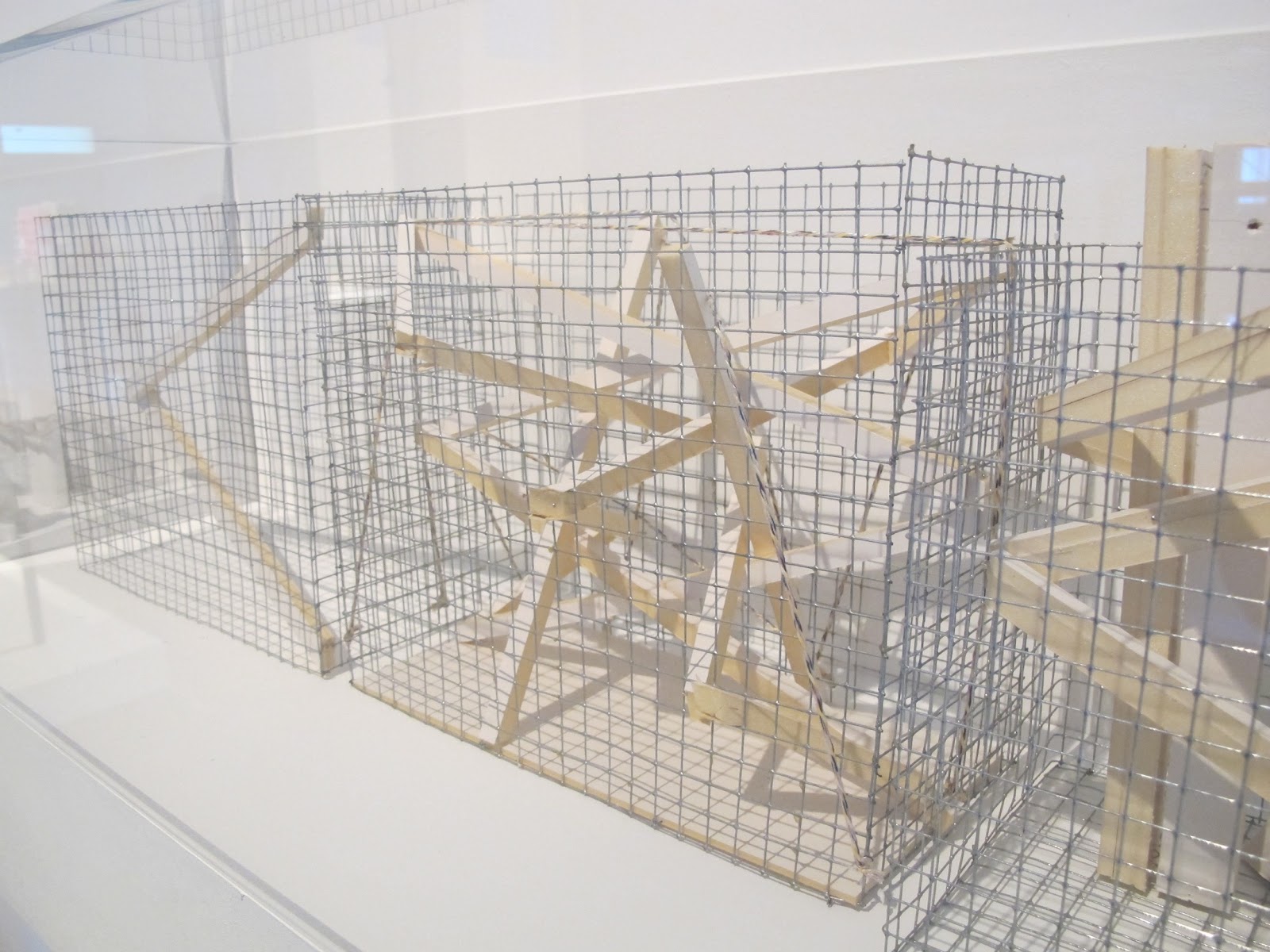
The ground floor snaps entering visitors to attention with a room-full of rare masterpieces, many of them brilliant visions which never were, interspersed with tabletops stuffed with mass and volume studies of foam and wood and preliminary designs whose forms are as adventurous and ingenious as their choice of materials such as the drinking-straw dome of the Montreal Pavilion proposal. These early-stage demonstrations continue of the top floor, such as the number of studies for Christian Kerez's unbuilt Swiss Re: Headquarters in Zürich, which reached its climax in a refrigerator-sized wooden assemblage of floors, beams, ramps, and stairs.


Christian Kerez's unbuilt Swiss Re Headquarters in Zürich.

These are just some of the hundreds of items that the exhibit has collected together, some from its own vaults, some rare gems borrowed from the archives of old masters. Together, these might roughly fall into three categories: those places which exist in the world (models of real buildings, but which give license to show an alternate reality both in terms of scale with view but also material and transparency); ancient places which exist no more, and so those models which are the best representation of what was once real; and those places which have never existed: whose closest realities are the models themselves. Highlights include the tabletop hypermetabolist landscape of Arata Isozaki's Cluster in the Air to the smaller but equally wondrous proposal by Emilio Ambasz for the Center for Applied Computer Research, an unrealized Digital-Aztec precinct on the outskirts of Mexico City.

Detail of the table-size model of Arata Isozaki's Cluster in the Air, 1962

One of the more striking models in the whole exhibit: 
Emilio Ambasz's design for the Center for Applied Computer Research, 
Mexico City,1974-75

James Stirling's Churchill College proposal, Apr-May 1959


While these never-to-be environments, found on both the ground floor and the top, would alone make for a noteworthy exhibit, the second floor is particularly awesome: At model-railroad scales (most 1:200), the visitor can play bird, or god, hovering over the humungous dioramas of ancient, medieval, and modern landscapes, many of which turned to dust centuries before the helicopter. The room opens with the quintessential rotorcraft view: a frenetic five-block slice of mid-town Manhattan, bustling with taxis at the foot of the Pan Am Building and bending around Grand Central Station.


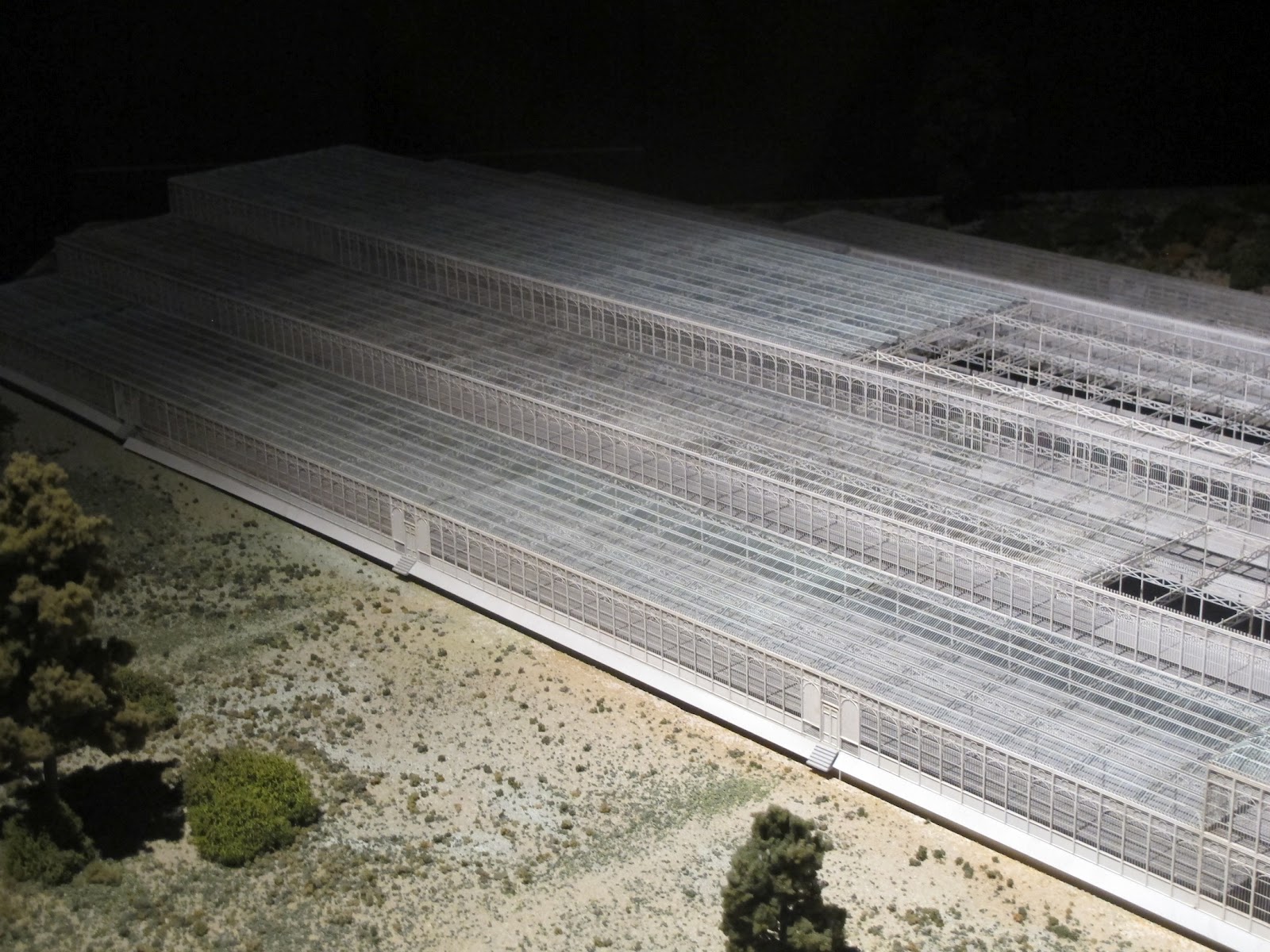
This bustle contacts with the eerie serenity of the other scenes nearby. In the whole exhibit there might be nothing so incredible a visual experience as standing alone above these landscapes of the never-more. Of all these, the lone model of the Crystal Palace presented the most jaw-dropping surprise. Even at the scale of an insect, the enormity of its enclosure is arresting, its relentless frame disappearing into the scene's dark far edge, as if it emerged from the blackness of lost history for the brief instant of this installation.


The Royal Crescent at Bath next door is similarly isolated yet, given its history, less forlorn. The other dioramas of even older times, stretching back all the way to Mycenae and Rome, Egypt and Sumeria, are not at all melancholy, but delightful and breathtaking. These might be more common in history or anthropology museums, if not toy emporiums, and certainly not in galleries of architecture, which is precisely one of the main reasons which its so refreshing to have the heart of the exhibit given over to such "popular" and non-academic displays.

The Royal Crescent, Bath.

A busy day in central Pompeii

The acropolis at Mycenae


Temple of the Pharaohs, Dêr El Bahari, Egypt.

Bruchfeldstraße Housing Development, Frankfurt-Niederrad, 1926-27

The Baroque town of Arolsen, North Hesse as it appeared in 1719


An unfortunate moment of sorts occurs as the visitor returns to the stairwell: the last diorama shows an Orinocoan settlement, a ring-clearing in the forest constructed by the indigenous Yanoama culture, one of the few moments of non-Indo-European architecture in the whole exhibit. Having seen these mono-structural villages in anthropological texts, I can attest to their impressive monumentality imbued with spiritual reasoning, which juxtaposes quite well with the square of Pompeii nearby and the Valley of Egypt across the room.

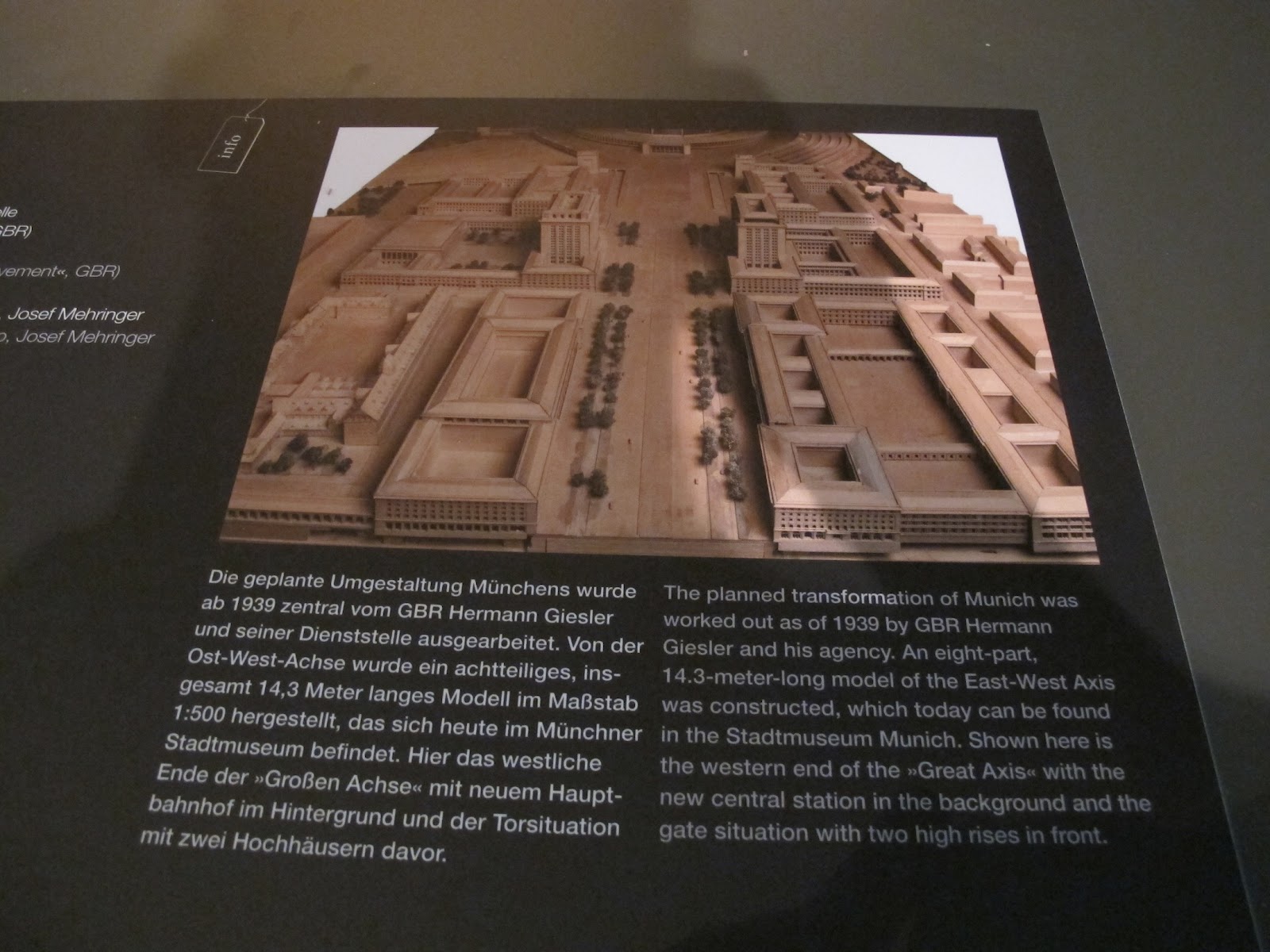
Yet the accompanying wall panel merely assigns the Yanoama the word, "primitive" which is at best a thoughtless translation, and at worst a very unenlightened classification system for a German institution to be using to categorize various peoples of the world. The more ignominious connotations of this moment are ameliorated by the floor above, which give over ample space to the importance of models in Hitler's Reich, with photos, texts, and objects from the office of Albert Speer, and the like.


The village center, a clearing the rainforest, ringed by dwellings, 
signature construction of the Yanoama, 
and how these "Indians" are described on the wall label.

A placard explaining the fascist plan for Munich, 1939.


While there is plenty of text for student or professional visitors, cueing into process, explanations of formal evolution, struggling with formal idea to execution, the constraints of construction, material, and reality, these aspects can become a bit heavy and technical, especially for those viewers who associate foam and plywood with late nights in the studio. With such a large exhibit, the great number of items to view is itself overwhelming. The exhibit might be most enjoyable in the unfamiliar moments of a micro-vista or a lilliputian skyline, understanding its translation to scale and contemplating the possibilities it suggests. These are sensations of another world.


A stunning series of small foam creations.

One particularly large display on the second floor is Foster and Partners' presentation model of the Commerzbank, one of hometown Frankfurt's most well-known skyscrapers. From this Vogelperspective, the tower still soars above the tops of heads, but the vantage point allows a view into the diminutive courtyard created by the successive arrangement of buildings of various heights and vintages, all dwarfed by the massive bank, which seems to have carved out a space in the air.


It is a simple matter of a 15-minute walk from the museum, crossing the Main on foot to see this architectural moment in person. While the model's white foam pieces come alive in brick, stone and glass in the sunlight, the dynamic might of the tower's mass against the block and older offices is somehow lessened from the street. Yet this arrangement of masses is more familiar now. Having looked down, it is better understood. For a moment, you flew above it, and could hold a tower in your hand. But you are no longer flying. The imaginary helicopter has landed back on earth, in reality.