Showing posts with label Da Hinter. Show all posts

Monday, March 10, 2014

Jimmy Fallon's Skyline

A few weeks ago, the Tonight Show starring Jimmy Fallon made its big debut. I don't watch a lot of television, much less late at night, but think Jimmy Fallon is a really clever, energetic, creative entertainer, and nowadays its easy to watch a handful of clips on YouTube and feel like you're at least partly aware of what is going on.


The Tonight Show has an all-new set, which follows the standard desk-and-couches-on-a-soundstage format. What I immediately noticed was the backdrop, which is made up of a panoramic photo image of Mahattan, but in front of it what was especially notable is a collection of more than three dozen wood building models.


The buildings are arrayed randomly in the display—their arrangement doesn't correspond to their true relationships, and it doesn't appear as though the models are to scale with one another. This makes identification a bit difficult, and I am also not certain that all the models have been detailed with equal faith to their original appearance. There is a small, laser-cut Pan Am Building, visible second from left above; it is less-detailed and more diminutive than the finely detailed McKim frontage of the NYP Library and the Chrysler Building just over Jimmy's left shoulder, which seem to use a variety of materials and might even be from a model kit.

During Justin Timberlake's appearance, its easy to spot the AT&T Building, directly behind the microphone, 
with what might be the Daily News Building behind. 
The Woolworth Building is easy to spot behind Timberlake at far left. 
I am tempted to suggest that the Building to its right, behind Timberlake's head, 


is the Helmsley Park Lane Hotel on Central Park South.

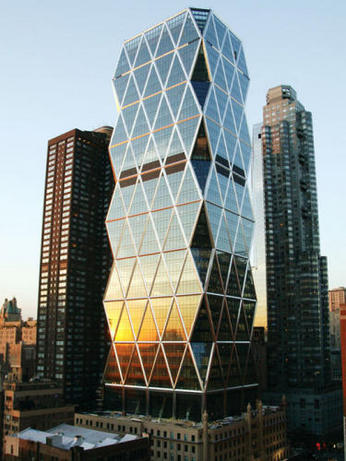
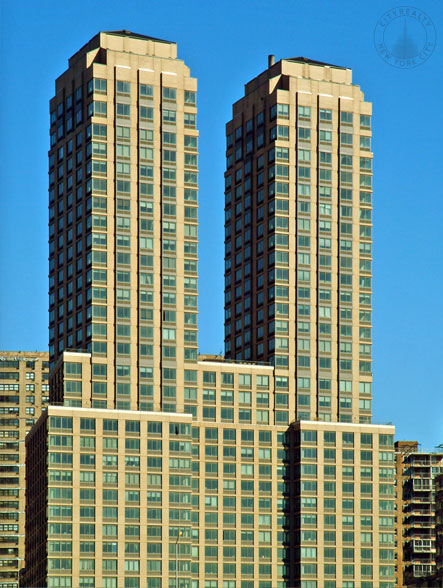
There are some interesting choices here, besides the world-famous landmarks such as old as the Woolworth and Chrysler Buildings and as new as the One World Trade Center, there are secondary icons like Johnson's AT&T Building, Stubbin's Citicorp Center and Johnson’s Lipstick building. Some other notable inclusions include Piano’s New York Times Building, just behind Jimmy, and at the far left, normally not visible but clearly shown in these scenes of U2 and Will Smith, Foster’s Hearst Tower. Other recognizable but far less identifiable towers include post-modern art deco Trump Riverside, the bland corporate mid-rise of 4 World Financial Center, and the hipster Maritime Hotel.

The Chrysler Building shines behind Fallon's right shoulder, with the Lipstick Building in front. 
Behind Fallon's left shoulder, in the shadows at far right, is Piano's New York Times HQ, 
with a twin tower from Trump Riverside in front. 

There is a foreground layer of low-rise landmarks, too, including the Arch in Washington Square Park, the Pier 17 at the South Street Seaport, the Guggenheim, New York Public Library, the New York Stock Exchange, and the tripartite arrangement of Lincoln Center.


During U2's performance, 1 World Trade Center and the Hearst Tower are clearly seen behind the Edge. 

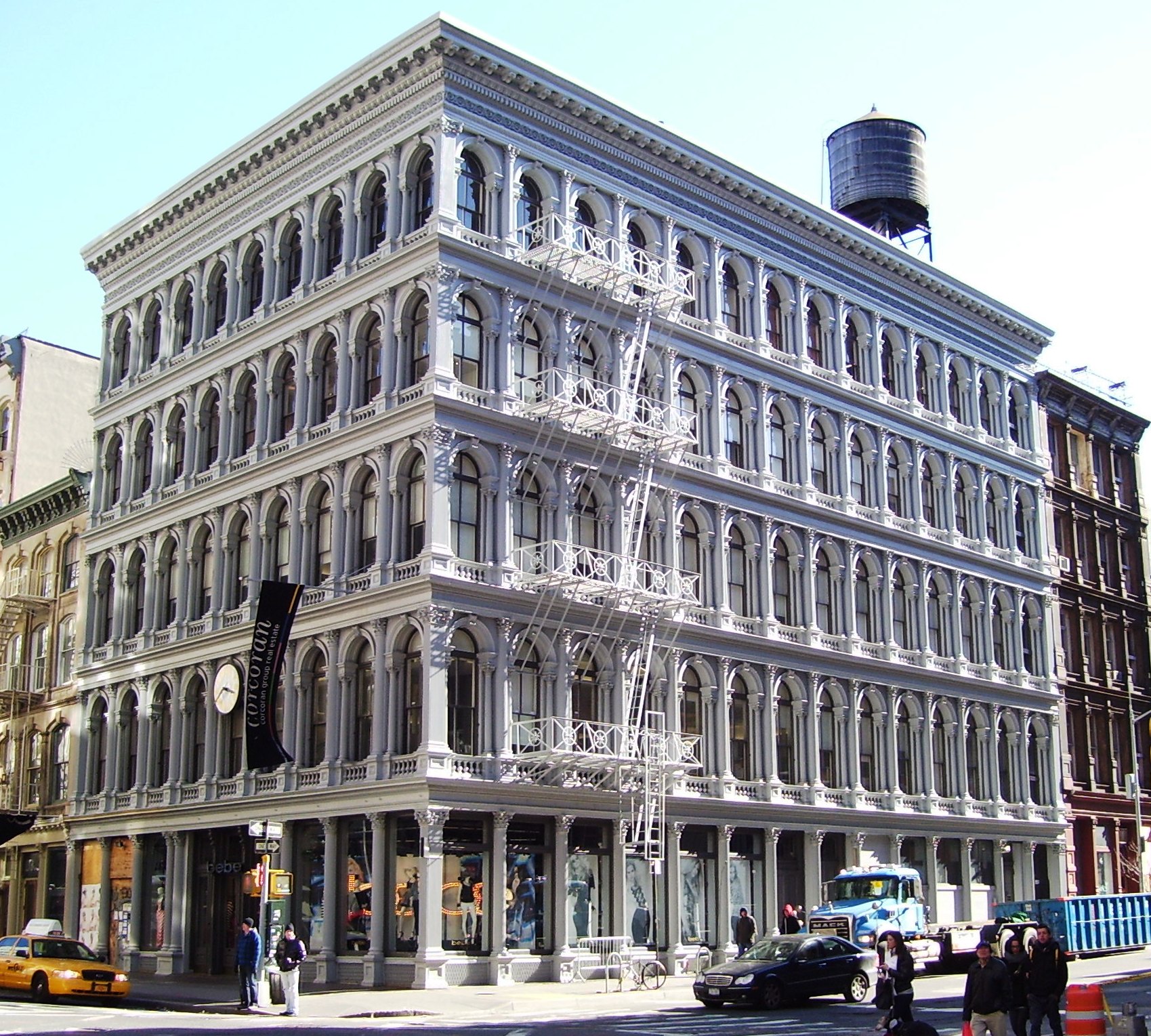
But still, I was only confident in labelled a little more than half of them: is that the Daily News Building just over Jimmy's right shoulder? Is that big, French-Empire Style manse behind the guests, with its green-copper roof, supposed to be the legendary Dakota apartments? Others, like the sample Tribeca warehouse and the prototypical SoHo cast iron façade, would be laborious to pinpoint to a specific real-life building. For all I know, a third of the models are just made-up, and not based on real buildings. I certainly suspect that is the case, even with the larger models such as those between the Chrysler and Citicorp to Fallon's left, at the far right of the background.

Kristen Wiig impersonating Jason Styles. Lincoln Center is clearly visible at left, 
with what appears to be a tiny Guggenheim Museum in front. 

Behind Kristen Wiig, on her right: A SoHo building, Pier 17, the Dakota? 
On her left: a TriBeCa warehouse, Lincoln Center at lower right, and the Maritime Hotel behind.

When Jerry Seinfeld visited the new show, while praising the show, he turned around admired the elaborate background:

”I love the set. I love the rich kid NY chess set. This is the upper east side kid's chess set. It's beautiful, but I would move the chrysler building to king 4...”


Here is a quick diagram I made of the display, with whatever buildings I could identify. Suggestions for changes or additions are welcome in the comments section: 


Sunday, December 1, 2013

Bauzwangsvorstellung: Holiday Inn London


Of London's tall buildings, the best, the strangest, the most admirable are the decades-old, concrete chess pieces of West London, solitary sentries guarding these residential quarters. They make a striking juxtaposition in shape, size, height, and material, contrasting with the cream-colored terraces and garden squares. 

I spent a lot of time in London during the middle of this year, and could see the Holiday Inn Kensington from the window of my bedroom. It is startling and hideous, a massive wall of crummy, soulless hotel rooms, the largest building of the tourist-lodging district of busy Cromwell Road, which deposits foreign tourists from Heathrow Airport into ‘posh’ West London. 


The building makes an even more striking contrast nearby, as the hotel looms over the large and surprisingly quiet garden square nearby, Cornwall Garden. If the area had more tall buildings, the effect would be diminished, but this westernmost hotel high-rise of West London stands by itself. 


Tuesday, October 15, 2013

The Banks


 LONDON.

Among the landmarks of London whose appearance from afar is considered precious, the Palace of Westminster, positioned particularly on a broad curve of the River Thames, is among the most sacrosanct. The views towards Parliament are protected by an act of Parliament.

It is therefore strange that either side of this critical, historic stretch of London's brown artery stretches an increasingly incongruous phalanx of large, tall buildings.


Partly, this is a result of the property and preservation paradox itself: water views are always valuable, and the wide vistas across the water, itself mostly free of buildings, make its edge a prime location for prominent buildings, beginning with Big Ben itself.

But, like in so many other rarified quarters of the capital, when post-war Britain needed to rebuild, and as later decades came, architectural statements needed to be made, bold new buildings of varying merit rose up on either side of the river.

It all started out rather well when peace came more than half a century ago: not least the brutalist Festival Hall, which is often considered one of London's best 20th century buildings, and deserves its own consideration aside from this overview. But perhaps this lovely, brave civic endeavor opened a pandora's box of contemporary construction, an outflow which is accelerating even now, all around it.

Charing Cross from the London Eye: 
Peering down on Thatcherist public monument from Blairite cool tourist icon.

 Directly opposite is exhibit A: Charing Cross, Terry Ferrell's high-pomo shopping shed train station, welded to the back of the dainty Victorian railway hotel, a monument to late Thatcherist love of American commercial argot in all things, especially civic infrastructure.


Since the Millennium, the mid-century leisure attraction has been overshadowed in all senses by the London Eye, which itself has become a jewel in the crown of London's indisputable architectural icons. It's nice, and playful, and neat, and family-friendly, and touristic, but it's not in the least respectful of its context, usurping the stately sweeps of parliament for its own ticket receipts.

South Bank, in the very near future. 

Of an earlier era, and what seems now almost quaintly more controversial at the time, was the Shell Centre, a stone-white office tower lovingly celebrated in this contemporary film below, when riding in elevators and working more than three stories above the ground was a marvel. It will soon by joined by more high-end speculative developments.


Among the oldest skyscrapers along the Westminster side of the Thames is the bulky Millbank Tower, built in 1973 near the site of the old Millbank Prison. Standing like a third tower of parliament, after Big Ben's Clock Tower and Victoria Tower, it is hard to photograph Britain's legislative house without this drab block in the background. It was once a home to Britain's Labour Party, somehow fittingly.


This monolith is now joined by the "riverside stunning development"of St. Georges Wharf, a green-glass Vancouver-upon-Vauxhall that manages to become increasingly obnoxious as it slowly metasticizes decade after decade.


The first mega-structure of the Lambeth shore was Terry Ferrel's second superstructure facing the mid-Thames. Known variously as the MI6 Building or SIS Building, it was built on spec until Thatcher let the spooks lease some floors. Aside from having its naming-rights occupants be a government agency whose existence wasn't acknowledged for decades afterwards, the building's realization is unbelievable in two aspects: firstly that a faux-copper-capped neo-art-deco ziggurat would be proposed anywhere, and that a government's clandestine intelligence division would occupy a bombastic Babylonian building on such a premiere site, a Legoland Lubyanka in Lambeth done up in Michael Graves Mesopotamian. It was famous even before it featured memorably in the otherwise forgettable 2012 James Bond episode Skyfall. The secret police have a celebrity building.

It might have been easier to just not build it in the first place…

Then its Canadian cousin arrived

What could possibly share space with such a ridiculous building, other than luxury flats? A decade after the secret government agency openly moved in to its bankside behemoth, a vapid, Vancouverish, over-fenstrated fortresses. Nominated for a Carbuncle Cup on completion in 2006, it goes to show how much bad architecture is produced every year that this shiny flock of seagulls lost to an even worse building. That this bizarre pair are in and of themselves unquestionably referential just illustrates how warped the contextual parameters of the Thames have become. London wasn't first to the finish line, yet it now enjoys a quintessential 'stunning riverside development.'


The royal heir did not arrive until 2013. It is again glassy and green, but instead of a sprawling palace, it is a tower. It's realization in this once-distant corner of the city is emblematic of how, in just a decade, all efforts to hold back skyscrapers from London's skyline and its neighborhoods have been exhausted under the foot-tread of property developments. Together with the 40-year old Millbank tower, they stand like pillars of Hercules, ominously blocking the source of the Thames, triumphant in their fight over what this city will ultimately look like.


But it is not a war without real-life casualties. In what seemed not only ironically-reminiscent of the kaboom from the Daniel Craig Bond flop, but also an epic allegory for this era of high oligarchy, a helicopter, whizzing across the grey early morning with important people in a rush, struck the tower crane as it was crowning this latest yuppiedrome. Flames and debris not set off by Hollywood effects specialists rained down on the morning joggers and bikers along the river. Two died. A baptism by fire by helicopter crash; buildings have been deemed cursed from far less.

If there's death to be mourned beyond this loss of human life in all this technological violence, perhaps this is yet another eulogy for part of Britain itself? For in all the hand-wringing about view corridors, what is meant to be preserved, what is wished distilled, is the concept of a country, a place not of property speculation but pastural charm, even in its great, grand capital. Of late, this heritage has extended to the honoring the technological past, the age of engineering which gave Britain its summiting might, and so much of its great architecture.


That this would be the alluding myth of an office building for lobbying speaks to the sorry condition of both building design and its society. Michael Hopkin's addition to the Parliament promenade, Portcullis House is not even necessarily a bad building, and it is certainly not the worst that one's eyes could meet, scanning the skyline from the panoramic viewpoint of the river's shores. But neither is it great, for such a great and celebrated spot; it's a minor player in an orchestra, drowned out by bigger instruments, which play an incongruous tune. If that song were a paean, what myths would it lyricize, for us to believe that the river passes by heroes, as it winds through this capital and out to the sea. 

Saturday, October 12, 2013

Victor Victoriana

Above: Portland House & Westminster Cathedral over Green Park. ©2013 Bauzeitgeist. 
Below ©Google.
LONDON.

The increasing hideousness of the City of London's skyline is frequently decried just for the ugliness of the new architecture itself, but the loss of the capital's historic vistas, mentioned in terms of the now-carefully-studied "view corridors"–of St. Paul's in particular but also the Houses of Parliament in Westminster. The new glass-and-steel financial towers block the distant appearance of the cathedral's dome or the heroic Big Ben and Victoria Tower of Parliament. Paradoxically, the concern over these sight lines seem to overshadow the demerits of the new skyscrapers themselves, which it seems can be hideous as long as they are a referential distance  from London's more ancient landmarks.

A counterargument to this is that it ignores all the terrible office buildings that have been rising in prominent locations across London for decades. As mentioned in the last post, this is a different issue in leafier west London, away from the narrow jagged alleys of the medieval City. These more residential areas have had fewer demands for tall buildings, more restrictions on new construction, and are home to two of the capital's largest parks, the perimeters of which space out a handful of tall towers, most of which were realized decades ago.

Portland House over the top of Green Park. ©2003, 2013 Bauzeitgeist.

The West London district that most closely resembles the City of London is Victoria. Before ever visiting Britain, I heard the name, and assumed that only one of London's nicest areas would be named after a queen. But this is not the case. The grandeur evoked by its moniker seems grossly misapplied to the tangle of busy, dirty streets, in misnomers like the busy Buckingham Palace Road.

171 Victoria Street, HQ of John Lewis.

Victoria is sort of the District of Columbia of London, with a heavy dose of Madison Square Garden at its center. Home to a large portion of the British government, it features several busy thoroughfares lined with dull office blocks, home to a lot of the back-office bureaucracy and the UK lobbying industry. This sad zone stretches between Parliament and Buckingham Palace, forming a triangle with its namesake, the enormous Victoria Railway Station, an ugly procession of dusty sheds, which somehow managed to become even more revolting by a partial conversion to a low-ceilinged shopping mall, which itself continues on to a massive bus terminal, its steel frames covered in several decades worth of dust and pigeon poop. An analytical post could be dedicated to just this low-lying carbuncle itself, oozing across the southern threshold of one of the world's most expensive neighborhoods, minutes from bedrooms which go for a million-and-a-half pounds each, and a 15-minute walk from one of the most famous houses on the planet.

Victoria Coach Station, Buckingham Palace Road. ©2006 Bauzeitgeist.

The other side of this district hosts a handful of half-tall, boring office towers. What is most shocking to a visitor's sensibility is that this cluster of buildings, a sort of office park right in the center of Westminster, is within a few blocks of one of the greatest monuments of modern monarchical mythology, Buckingham Palace. The group of dull blocks spoil the background of the pristine royal fantasy, Green Park gets the backdrop of a suburban office park.


The most noticeable building to rise over the treetops of Green Park is Portland House, a building so bland it is hard to pick it out of a lineup. As if the area between the regal Mall and the train station wasn't turning out badly enough, somehow a shortened Pan Am building (with nearly identical octagon shape and depressing ground floor porticos) dropped down like a lead curtain; the Monster that ate the Green Park. In a classic Maupassantian moment, the property company boasts of the tower's "stunning views" while Portland House prominently detracts so many others from elsewhere in the city.

Portland House, visible with Big Ben, the Shard, Victoria Tower, One Canada Water, and the Westminster Cathedral.
©2013 Bauzeitgeist.

In a quintessential New-Ruins-of-Great-Britain move, the forecourt was done over ten years ago as a glass-domed mall, so the cubicles full of bureaucrats could have their basement gym and food court and shopping. The fourth floor is leased out to the Kazakh resource group that is currently taking over disgraced commodities firm ENRC.

The front of Buckingham Palace, with Cardinal Place and Victoria in the background. 
©2013 Bauzeitgeist.

If anything could ruin the scene from Buckingham Palace more than this, it would have to be the erstwhile Home Office, now the Ministry of Justice, which today, like all soulless structures, is most commonly referred to only by its street address, 102 Petty France. Perhaps only in England could such an enormous and over-bearing structure somehow end up referred by such a cute little name as Petty France, as if the façade's fenestration referenced a particular style of lace doily rather than a Brutalist blockbuster.
This is another realization of Sir Basil Spence, designer of the Household Calvary Barracks covered in the last post. Celebrated another of the most hated buildings in Britain, it caused a Lord to once remark that Spence ruined two London parks with his monstrosities: the Household Calvary wrecked the bucolic idyll of Hyde Park, while the Home Office destroyed the serenity of Green Park (Portland Place aside).
Whether to instills admiration, or admonishment, its mass make one of the most compelling attractions of the whole quarter, another helmeted, cement-paneled soldier rudely wrecking a precious royal vista. Its block-long body features  a double-row of giant goggled bay window galleries staring wide-eyed at the street, monitoring. The higher stacks feature more repetitive windows, its bulbous noggin blotting out even more light. This bureaucratic fortress remarkably resembles the J. Edgar Hoover Building, the FBI Headquarters in Washington, DC, and is therefore all the more fitting that the building's apparent nickname was Lubyanka, after the enormous palace headquarters of the KGB in Moscow.

(4) Previous photos of 102 Petty France ©2013 Bauzeitgeist.

Its tempting to conclude that this repulsiveness was somehow intentional, that the bloated absurdity of this building, while a fitting home to a bloated agency of bureaucracy, was in fact impugning the ridiculously over-large imperial manor sitting just a short walk away–that the narrow lane of Petty France was the closest that Spence could get to stage his protest.


Monday, September 17, 2012

Frankfurt und Anderswo


FRANKFURT AM MAIN.

Journalists have employed the term "Mainhattan"regularly over the last two decades to describe Frankfurt, ostensibly due its thicket of high-rise financial towers that has risen across the west-end of the city. Frankfurt's American-style "downtown" skyline, began rising in the mid-1970s, never 'exploding' so much as growing bit by bit, as it does today. Frankfurt looked remarkably different from any other European city.

Although somewhat renown in the recent past as the most substantial skyline of continental Europe, this hyperbolic moniker's impact has diminished as European skyscrapers became less unusual, and especially as European skyscrapers have become more common, such as post-1990s Rotterdam or Warsaw, much less when considered against the hundreds of formally-flat cityscapes from Doha to Shenzhen which today appear as a shimmering walls of highrises.


Top: southeastern Frankfurt: The Romer, the Main Plaza, the ECB Tower
Bottom: Central-East Frankfurt, the Zeil Hochhaus and Jumeirah Hotel at Left, the ECB at far right.
©2012 Bauzeitgeist.


Not that anyone besides journalists and architectural enthusiasts have ever used the term "Mainhattan," But to at any point call Frankfurt's small cluster of not-particularly-tall buildings a peer to New York's miles-wide skyline was always ridiculously overblown. A more appropriate, if less cosmopolitan, reference would be to a similarly-sized and shaped American city. Frankfurt's skyline was never more substantial or impressive than the elevation of downtown Pittsburgh or Nashville.

 Left: Messeturm, Frankfurt, by Helmut Jahn, 1990.
Right: NationsBank, Atlanta, by Roche Dinkeloo, 1992.
Both images via Wikipedia Commons.

If the comparison should have always been more Mainneapolis than Mainhattan, then at least, in those years, American economic might was still the pinnacle of achievement, worthy of imitation and adoption. Architecturally, this is particularly manifest of that lengthy golden age of post-unification, pre-Euro Germany, when an optimistic Frankfurt embraced corporate American postmodernism as the face of its increasingly intra- and intercontinental financial district.

What had begun as a few German-designed glass boxes pre-1989 was joined by colorful, whimsical bank buildings rising up around the Bahnhofvertiel, of the same generation as the neoclassical office towers that became the tallest buildings in many American cities from Cleveland to Charlotte in the 1990s, as both continents reached the apex of transatlantic corporatism.


Left: Westend Tower, by Kohn Penderson Fox, 1993. Photo ©2003 Bauzeitgeist.
Right: US Bancorp, Minneapolis, by Pei Cobb 1992. Image via Wikipedia.


This resulted in such towers as the pyramid-capped Messeturm, which would not look out of place in Atlanta's midtown; KPF's Westend Tower, whose curving-white brise-soliel was, its hard to comprehend now, seen as daring when it was completed, spawned identical hundreds across the North America from Miami to Vancouver, later spreading to other continents. Yet Westend Tower completed a year after Pei Cobb's US Bancorp in Minneapolis opened in 1992, crowned with a similar fan.

Lastly, and while not copying so closely an particular tropes of American post-modernism, the strangely-crowned Trianon Tower has no closer kin than the Centerpoint Energy Plaza in Houston.


Top: Centerpoint Energy Plaza, Houston, with its 1996 crown. ©2003 Bauzeitgeist
 Bottom: Trianon, Frankfurt, built 1999. ©2003-2012 Bauzeitgeist

At least a few in Frankfurt seemed to take the city's gothamist nickname somewhat seriously. In looking at the architectural record, this is best supported by the extremely curious Main Plaza, on the south bank of the Main, a hotel tower which seems to directly copy Raymond Hood's 1924 Art Deco American Radiator Building in midtown Manhattan (and Chicago's Tribune Tower), which itself was inspired by gothic architecture: a transatlantic style boomerang; post-modern irony at its pinnacle.


Top: Main Plaza, Frankfurt, 2001. Photo @2012 Bauzeitgeist.
Bottom: American Radiator Building, 33rd Street, New York, by Raymond Hood, 1924.
Image via Wikipedia Commons.


On a recent visit to Frankfurt, specifically to view the exhibit at the DAM, two prominent additions to Frankfurt skyline show that Frankfurt's skyscraping continues on, but perhaps with new influences and inspirations. In the center of the city, just off the Zeil, the city's wide fußgangerzone, rises the stylish Jumeirah Hotel, the newest outpost of the Dubai-based luxury hotel chain.


Its highly-contemporary exterior, characterized by jagging and wiggling elevations and punched by stochastic slits of windows, employs two popular devices from the contemporary architecture kit of the last few years, which can be found in the United States as much as anywhere (such as the "curving" and "sexy" Roosevelt University Tower which has invaded Chicago's historic Michigan Avenue district. The Jumeriah takes the same jagged shape, while also being reminiscent of the Hilton Hotel in Houston.


 Jumeirah Frankfurt and the Zeil Hochhaus.  ©2012 Bauzeitgeist.

This new developed is adjacent to the historic Thurn und Taxis Palais, but the hotel does not utilize the older building for a substantial street presence or spacious lobby. Instead, a narrow corridor with lectern-sized front desks opens directly onto the ground floor of one the bustling, glittery, mid-market malls which dominate the pedestrian shopping precinct. While linking luxury towers to malls is a standard real estate cocktail around the world, its a formula which is waning in North America at the same time it is worshipped in Arabia, and it seems telling that luxury was conveyed in this particularly non-European fashion.

Hilton Hotel Houston ©2003 Bauzeitgeist.

The Jumeirah, part of the  Zeil Hochhaus I & II phase of the Palais Quartiel development, might therefore be best described as a Gulf hotel in a German city, programmatically, stylistically, and architecturally following the bland luxury development formula that is applied in cities everywhere nowadays.

What is therefore more remarkable both in scale and its peripheral location is the substantial European Center Bank Headquarters at the southeastern limit of the city center, at the Großmarkthalle, a vegetable market which also played an ignominious role in assembling deportees from the city during the Holocaust.


This huge complex rises outside the normally skyscraper-belt, and it is interesting to speculate on the meaning and impact of the ECB's new location, whether this move from the Bahnhofverteil to the Großmarkt marks Frankfurt's shift from its City to its Canary Wharf, especially when viewing central Frankfurt's distant cluster of skyscrapers from the riverfront, docklands-like construction site around the Großmarkthalle. German cities never shielded their centers from development like Paris, but its most skyscraper-strewn city may yet get its La Defense.


Frankfurt's Docklands: The Großmarkthalle site at a bend in the river, 
southeast of the city's center, with the existing financial district several miles distant. 
The Main Plaza is at mid-center left, behind the bridge. 
See Google Earth image at top of post to note how the oxbow bend of the Main echoes the Thames at the Docklands.
Above Image via Wikipedia.

The huge ECB premises, with twin towers pivoting toward each other at an angle connected by multiple, cantilevering sky-bridges between, is dashingly contemporary in its styling. This is the latest iteration of an emerging kinship of such twin-towers, most especially such supersleek developments as the World Trade Centre in Bahrain, which has been mentioned in this blog a few times before.

Bahrain's World Trade Center, c.2008. Image via Inhabitat.


A fable for our times, the ECB has been working on a substantial new building throughout a crisis which now impugns the very concept of a centralized Europe, which has lead no less than George Soros that Germany should either save or leave the Euro. 


While last week's announcement that the ECB development would be overbudget by 41% was met with exasperated derision and humor, that the ECB seems to be emulating new financial capitals much farther to the southeast from its old offices, the sovereign-wealth-fund federation between Doha and Abu Dhabi, with a glittering, Gulf-like financial center. Rather than recall a more rational and socially beneficial heritage of finance, the ECB's architecture reflects out to the flashy new centers of money.


Frankfurt has never been a large city, or at least, never larger by area or population than other German or European cities. Its markets and banks, the vast convention halls of the Messe, and its busy, centrally-positioned airport have made Frankfurt a global city. However, this isn't the same as being cosmopolitan, in the same way that its important book fair is not make Frankfurt a center for literature. As stated in the Guardian earlier this month, even as it has continued to persevere as a global banking center, Frankfurt has never grown into a metropolis.

Despite its under-rated museums and its pleasant quality of life, Frankfurt is only a cross-roads of trade and transport, without the overlay of romance and art that defines London or New York. Its central district holds the late-evening routes of lonely foreign businessmen, not the storied streets of a world capital. Frankfurt may so badly wish to be compared to these sophisticated cities, but it continues to grow by building upward with skyscrapers evoke those duller, more commonplace business districts that are its true peers.