Showing posts with label Bücher. Show all posts

Friday, March 14, 2014

The Anachronistic Quality of the Word Skyscraper


He went outside and crossed the avenue, then turned and faced the building where he lived. he felt contiguous with it. It was eighty-nine stories, a prime number, in an undistinguished sheath of hazy bronze glass. They shared an edge or boundary, skyscraper and man. It was nine hundred feet high, the tallest residential tower in the world, a commonplace oblong whose only statement was its size. It had the kind of banality that reveals itself over time as being truly brutal. He liked it for this reason. He liked to stand and look at it when he felt this way. He felt wary, drowsy and insubstantial. 


The wind came cutting of the river. He took out his hand organizer and poked a note to himself about the anachronistic quality of the word skyscraper. No recent structure ought to bear this word. It belonged to the olden soul of awe, to the arrowed towers that were a narrative long before he was born. 

The tower gave him strength and depth. 

—Cosmopolis, by Don Delillo, 2003

Although the book doesn't name the building explicitly, the description of the world's tallest residential building, on First Avenue in Manhattan, means it can only be the Trump World Tower.

photos ©2011  Bauzeitgeist.

Sunday, August 5, 2012

Sommerlesung: Insuring the City


©2008 Bauzeitgeist.

Occasionally, a visit to the bookstore, for those who happen to live in a place where such an errand is even possible, results in a discovery of a newly published book which is unexpected in a euphoric but somewhat devastating way. The existence of a volume on a subject so esoteric that the idea that you alone were interested in it was plausible, is a source of joy; that this insensible idea is dashed by the presence of the book on the shelf is a cause for surprise, and the small lament that you are no longer the lone expert on this particular topic (and therefore, with the discovery of this newly-published book, not the one to write the definitive account of the subject? Perhaps a cause for a small but powerful sadness).

©2008 Bauzeitgeist. 

Even if none of that makes any sense, never mind. Here is a book to read: Insuring the City: The Prudential Center and the Postwar Urban Landscape, by Elihu Rubin, published by Yale University Press earlier this year. The book tells the story of the Prudential Center, one of the largest office buildings and commercial developments ever realized in Boston or New England, chronicling the economic, commercial, social, urban, political and architectural thoughts and movements that brought about this unusual tower and the multi acre "Prudential Center" arranged at its ankles in the center of Boston's midtown Back Bay district. 

©2008 Bauzeitgeist.   

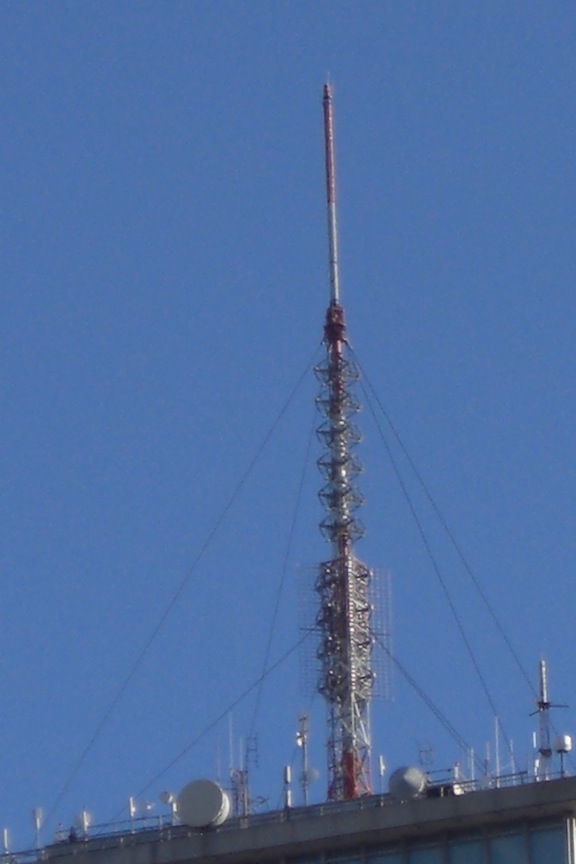
I lived in Boston for many years. It was my first city-- my first time living in a city as an adult. I lived only a few blocks from the Prudential, and in more than one apartment had a view of the silver-grey-green bulk which towered over the red brick and rooftops of the older townhouses of the area. I can't say I came to love the building, but was certainly always fascinated by it, its hideous metallic grille body, its weird, anthropomorphic capital, crowned with dozens of antennae, and embossed with a corporate label as if a slip of paper had passed through a massive typewriter. The building seems to so rudely destroy the historic charm of the Back Bay's mannered, leafy streets, and yet is itself somehow hopeful and silly, broadcasting its simplistic, vintage optimism.

 ©2008 Bauzeitgeist.

That the Prudential Center is so ignored, unloved and loathed a landmark  in the common estimation of both Boston's citizens and visitors, which was produced nearly 70 years ago by an unappreciated, no-name corporate architect, certainly makes it an unusual subject of a full publication of academic architectural enquiry. That an architectural historian has successfully brought to print a novel-sized volume on not only this building's history but a footnoted account of its creation and execution is equally too infrequent. 

 ©2007 Bauzeitgeist.

In five thoroughly researched chapters, Rubin details the architectural heritage of the Prudential Insurance Company of America, particularly its nationwide Home Office expansion program, which resulted in striking if rather conservative new office blocks in Newark, Los Angeles, Chicago, Houston, Jacksonville, and Minneapolis. To see a major corporation undertake a multi city building program in the midst of America's urban abandonment, and to have this occur for specifically pro-urban reasons, underscores how different corporate citizenship was seventy years ago from today. For more on this, see the inevitable Atlantic Cities post on the topic, in a review the book from June, which includes a reply in the comments section from the author himself.

 ©2008 Bauzeitgeist. 

Rubin devotes two chapter to the social and political environment of Boston at mid-century, when a parochial backwardness thwarted the implementation of modern architecture in the historic city, which was followed by a corrupt political machine. The book passes briefly over the sudden, shocking arrival of modernist urban renewal in Boston by momentarily referencing the West End, Government Center, and the Central Artery, all of which involved expunging huge areas of the centuries-old core of the city and interrupting the historic street pattern. It would be interesting to juxtapose these more thoroughly, along with the subsequent Christian Science Center near the Prudential, to show them as one class of similar urban renewal upheavals. 

The Prudential from South Boston. ©2012 Bauzeitgeist.

The book stays on topic, detailing the state and local tax schemes which kept the Prudential project alive. The final chapter reflects on the intervening time since the initial construction, in which the towers in the park Prudential Center was first revitalized as an upscale shopping mall, a program which remains in place today to great success, and in the last ten years has resulted in smoothing out the edges of this originally-inward-looking  development. 
The Back Bay Skyline from the Charles River. ©2010 Bauzeitgeist.

If there is one complaint about the book, its that this ending is rather rushed: although the later 1980s, 1990s, and 2000s additions are mentioned in the last few pages, a more thorough architectural examination of the changes to the character and function of the whole center by these changes would have been welcome. These projects are nearing an end, as the last available spaces in the Prudential Center have been filled in or spoken for, but it is interesting to look at this three-decade maturing and how it reflected changing social attitudes toward city centers, as the modernist plan of multistory retail plazas and prospects, good in theory but dreary and windswept when opened, were internalized into a suburban style mall. A later era, just passed, saw the addition of new luxury condominium towers (there were always luxury apartment buildings on the site) which lastly culminated in the addition of the Mandarin Oriental Hotel & Residences in the mid-2000s, which was not only one of the most prominent developments in Boston during the recent real estate boom, but also created a traditional urban street facade along Boylston street where previously there had been a driveway. 
The Prudential Center shown in axonometric on a Transit Authority 
wayfinding placard at Back Bay Station. ©2010 Bauzeitgeist.

The only other complaint about the book, and the more significant one: the novel-sized publication contains only black and white photos, and most of these are tiny, and pushed to the edges of each page by lengthy blocks of text. Vast panoramas of the Boston skyline, and presentation drawings that are surely huge in their original form, are  miniscule. This is a shame; perhaps the publication could have done with a series of plates in the center. This would have had the additional effect of showing some affection to the building itself, which remains a prominent landmark in Boston, yet one that is universally unappreciated.
The Prudential in a wooden model of the city of Boston
by the Boston Redevelopment Authority. 
The Mandarin Oriental Hotel is the two mid rise blocks at the center of the picture, 
to the front and left of the Prudential Tower. ©2009 Bauzeitgeist. 

Insuring the City isn't a typical read for any audience: its neither a general interest publication, nor is it the sort of books architects usually buy. Its not theory, and its not a coffee table monograph. Its dozens of pages of text only interrupted by subheadings like "The Bond Market" or "The Pubic Authority Model" or "Toward a Tax Concession." But this is also what makes the book so worthwhile, so important, so relevant, and so recommendable, for if chapters about creating a special purpose vehicle for a major corporation to develop a multi acre urban site isn't the typical book that architects pick up (much less write), perhaps it should be. This, I believe, is exactly the sort of subjects that architects remain ignorant to their own professional detriment: this is the story of how major projects actually get done, in American cities as elsewhere, a tale which is usually the saga of clever developers and willing public officials than it is of architects taking a lead role. In what is left of the summer, I'd suggest this is exactly the sort of book that architects should be taking to the beach. 

Wednesday, March 30, 2011

Teju Cole's Open City


NEW YORK.

The year is only a quarter of the way through, and has already yielded a debut novel that is being highly acclaimed: Open City, by Nigerian-American author Teju Cole.

The book is clearly influenced by the writing of W.G. Sebald, and in many ways alludes to Sebald's masterpiece, Austerlitz. Part of the novel takes place in Brussels, and there is even discussion of King Leopold, discussion of ancestors surviving war-ravaged Germany, passages about the Holocaust, and a number of other discrete references to Sebald's scenery, including mention of crossing the English Channel--the opening scene of Austerlitz.

Cole's novel is very much its own work, however, with a more contemporary, and American (and African) atmosphere, centered on a far less anonymous main character, who in addition to his perambulations across Manhattan and his four-week visit to Brussels, spends many parts of the novel discussing his family and other relationships, including some wonderful passages recollecting a childhood in Nigeria, including Lagos.

Walter Benjamin, Freud, and a number of classical composers are also mentioned. The main character, Julius, is not merely a passively-observing, historical-recollection flaneur, but a young man of color who experiences New York main in terms of his own relationships. These other characters balance the narrative's psycho-geographical musings and are more critical to the action than Julius's wanderings.

These introspective strolls are delightful. Below are two architectural passages, one from the very beginning and the second from near the end of the novel:

One Sunday Morning in November, after a trek through the relatively quiet streets on the Upper West Side, I arrived at the large, sun-brightened plaza at Columbus Circle. The area had changed recently. It had become a more commercial and tourist destination thanks to the pair of buildings erected for the Time Warner corporation on the site. The buildings, constructed at great speed, had just opened, and were filled with shops selling tailored shirts, designer suits, jewelry, appliances for the gourmet cook, handmade leather accessories, and imported decorative items. On the upper floors were some of the costliest restaurants in the city, advertising truffles, caviar, Kobe beef, and pricey "tasting menus." Above the restaurants were apartments that included the most expensive residence in the city. Curiosity brought me into the shops on the ground level once or twice before, but the cost of the items, and what I perceived as the generally snobbish atmosphere, had kept me from returning until that Sunday morning.


It was the day of the New York Marathon. I hadn't known…To escape the din, which seemed to be mounting, I decided to go into the shopping center. In addition to the Armani and Hugo Boss shops, there was a bookshop on the second floor. In there, I thought I might catch some quiet and drink a cup of coffee before heading back home. But the entrance of the crowd overflow from the street, and cordons made it impossible to get into the towers. --Open City, pp. 8-9

From where I stood, I could see, behind the diner, the massive AT&T Long Lines building on Church Street. It was a windowless tower, a giant concrete slab rising into the sky, with little more than a few ventilation openings, which resembled periscopes, to indicate that this was a building rather than a dense brick fabricated by a gargantuan machine. Each floor was at least double the height of that found in a normal office building, so that the whole tower, intimidating though it was, came to only twenty-nine stories. The military aspect of the Long Lines building was intensified by the thickened corners, elongated shafts with which the building mimicked the form of a castle's keep flanked by gatehouse towers, and which concealed the elevators, ductwork, and plumbing. Those few workers who used the building, I imagined, must after a few years become moles, their circadian rhythms completely distorted, their skin depigmented to the point of transparency. Long Lines, which I continued to stare at, as though it had drawn me into a trace, seemed like nothing so much as a monument or a stele.


I was drawn out of my thoughts by the voice of a security officer: You can't stand here, move along, sir. I moved, and came down to the side street. --- Open City, pp. 218-219


Above images of Time Warner Center ©2005-2008 Bauzeitgeist.
Bottom image of AT&T Long Lines Building courtesy of Flickr user wallyg

Monday, January 31, 2011

Books of the Decade: Cloud Atlas


David Mitchell's wide-ranging epic 2004 Cloud Atlas begins, straightforwardly enough, as an 18th century, first-person, mildly Melville seafaring journal, and over the course of ten further sections, takes in a broad sweep of human experience from centuries past and present, and something hinting at post-human experience in the future. It is a thrilling adventure of storytelling craft and literary talent, and unlike any other fiction in its form and scope, leading to comparisons of Mitchell to the best novelists of the English language, of any age.

Chatham Island, New Zealand courtesy Flickr user Newsbie Pix.

"Chatham Isle enclosed a vast eastern salt marsh lagoon, Te Whanga, very nearly an inland sea but fecundated by the ocean at high tide through the lagoon's "lips" at Te Awapatiki. Fourteen years ago, the Moriori men held on that sacred ground a parliament. Three days it lasted, its object to settle this question: Would the spillage of Maori blood also destroy one's mana? Younger men argued the creed of Peace did not encompass foreign cannibals of whom their ancestors knew nothing. The Moriori must kill or be killed. The Elders urged appeasement, for as long as the Moriori preserved their mana with their land, their gods & ancestors would deliver the race from harm. 'Embrace your enemy,' the elders urged, 'to prevent him striking you.'" -pp14-15 The Pacific Journal of Adam Ewing

Oostend, Belgium c.1975 courtesy Flickr user CanadaGood

"Kentish Queen slid into Dover's snaggletoothed twin sister over the mucky water, Ostend, the Lady of Dubious Virtue. Early, early morning, Europe's snoring rumbled deep below bass tubas. Saw my first aboriginal Belgians, hauling crates, arguing, and thinking in Flemish, Dutch, whatever. Packed my valise sharpish, afraid the ship might sail back to England with me still aboard; or, rather, afraid of my letting this happen. Grabbed a bite from the first-class galley's fruit bowl and dashed down the gangplank before anyone with braiding on his uniform caught up with me. Set foot on Continental macadam and asked a Customs man where I might find a railway station. He pointed toward a groaning tram packed with malnourished workmen, rickets, and penury. Preferred shank's pony, drizzle or no drizzle. Followed tramlines down coffinesque streets. Ostend is all tapioca grays and stained browns." -p.47 Letters from Zedelghem

Songdo City, Incheon, Korea. ©REX-NY

"What else caught your eye?
Oh, the greenness of green: back under the canopy, our ford slowed by a dew garden between squattened buildings. Feathery, fronded, moss drenched, green. In the dinery, the sole samples of green were chlorophyll squares and diners' clothes, so I assumed it was a precious, rare substance. Therefore, the dew garden and its rainbows sleeving along the fordway astounded me. East, dormblocks lined the thruway, each adorned by the corporate flag, until the waysides fell away and we passed over a wide, winding, ordure-brown strip empty of fords. I summoned up courage to ask Mr Chang what it might be. The passenger answered: 'Han River. Songsu Bridge.'
I could only ask, what were these things? -p202, An Orison of Somni-45

Sunday, January 30, 2011

Books of the Decade: Enduring Innocence

Keller Easterling, a professor of architecture at Yale, published Enduring Innocence in 2005. An interweaving collection of essays on the strange and astonishing built manifestations of late capitalism and neoliberal predicaments, Enduring Innocence introduces an entirely new vocabulary for the tragic and comic spaces that both hide and dominate, masquerade and overwhelm increasing landscapes of globalized commerce. Easterling calls these forms spatial products, and in less than 200 pages, employs a number of other excellent neologisms (indeed a whole new vocabulary for understanding the contemporary world), academic and philosophical references, and real-world examples as a sampling of the constructions of contemporary political-industrial-logistical regimes, and their agents and participants. With her amusing, enlightening prose and omniscient perspicacity, Easterling's volume shakes the reader awake from the celebrated dream of a harmonious, unified world to the casual violence of fractured, privatized, maximized landscapes. For more on Ms. Easterling, an extensive interview on Archinect is here.


"The greenhouse is a germ of agricultural urbanism that intensifies not only production but also labor and waste in agripoles the size of a city. No longer housed only when land or sunshine is sparse, as a structure within a field, greenhouses themselves are also propagated by the square mile in gigantic fields as a massive three-dimensional construction. An agricultural landscape is typically considered to be a cultivated form of exurban countryside, a self-cleansing counterbalancing organization of overlapping ecologies between animals, atmosphere, and vegetation. A landscape of greenhouses, however, is a continuous field of twelve-to-twenty foot structures. Since most greenhouse formations cultivate flowers, fruits, and vegetables for export, they are also international formations." -pp.39-40 (Chapter: El Ejido)

"While Ceuta & Melilla have sometimes been called autonomous communities, they are not colonies that will eventually contract for their independence...Both have been under Iberian control since the 15th century. While Spain claims that they have possessed these territories since before the establishment of Morocco, Morocco claims that this constitutes only a long occupation, not a property right. Fueling Spain's desire to remain in possession of these enclaves is the need to control illegal immigration...As the only two extracontinental European territories in Africa, Ceuta & Melilla are natural bridges to Europe." - p.60 (Contemplation: Seas)
"These automated devices, necessary for the seamless and increasingly efficient movement of goods, conflate the long-standing aspirations of cars, elevators, and rapid transit to achieve omnidirectional movement. Automated guided vehicles (AGVs), matured in the military, are now the devices of peacetime logistics, currently deployed in what the industry calls "materials handling." Throughout their history, these conveyance germs have been components of various futurologies with different political dispositions. While most of these future projections typically intone utopian scripts of frictionless passage and perfect responsiveness, most actually arrive with their own forms of friction, congestion, and failure" -p.100 (Chapter: Park)

Monday, January 17, 2011

Books of the Decade: Austerlitz

Austerlitz was the final work of literature by German author W.G. Sebald. Its English translation was published in 2001, the same year in which Sebald died in an auto accident in England.

Austerlitz recounts a series of coincidental encounters, in Antwerp, London, and Paris over the course of several decades from 1967 to the late 1990s, between a unnamed narrator and a mysterious architectural historian named Austerlitz, an endearing but troubled figure, haunted by his past, and hunting the elusive truth of this own identity. These uncanny meetings, and the fables, anecdotes, history lessons, and stories recounted by Austerlitz, make up the text of the novel and begin to record the man's search for his parents, and for himself.

Without revealing anything more about this staggering achievement of literature, which should be read in its entirely, but to properly celebrate one of the great books of the last decade, I wanted to recount a few passages in the tale in which the architecture of scenes take the foreground. Architecture, and the sense and history of place they create and reveal, are often the very agents which instigate and aide Austerlitz's search for his own past, and are thus very integral to entire work itself. As the story wanders across Europe, from Wales and London to Paris and the Czech Republic, bits of buildings and what they embody jar the memory of Austerlitz, both to what he knows as a scholar and what he has forgotten of himself, and reveal as much about the dark truths of our own civilization and past as that of this single individual.

Sebald was renown for his use of photographs embedded in his text, a technique still unique to published literature but rather prosaic in the world of weblogs. In shielding those who have yet to read Austerlitz with the many pleasures, sorrows and secrets of the work itself, and in honoring the masterpiece in employing its signature format, the selected excerpts below give a sense of Sebald's mastery, and are paired with very contemporary photographs, taken by Flickr users unknown to me, of the places and architecture concerned, which serve also to capture the unique atmosphere of the writing, which recount bits of distant history while the action of Austerlitz's wanderings take place in the contemporary world of a decade ago, which remains accessible and knowable to us.

I. Centraal Station, Antwerp.

When I entered the great hall of the Central Station with its dome arching sixty meters high above it, my first thought, perhaps triggered by my visit to the zoo and the sight of the dromedary, was that this magnificent although then severely dilapidated foyer ought to have cages for lions and leopards let into its marble niches, and aquaria for sharks, octopuses, and crocodiles, just as some zoos, conversely, have little railway trains in which you can, so to speak, travel to the farthest corners of the earth. -p. 6


image courtesy of Flickr user Justified Sinner


Towards the end of the nineteenth century, Austerlitz began, in reply to my question about the history of the building of Antwerp station, when Belgium, a little patch of yellowish-gray barely visible on the map of the world, spread its sphere of influence to the African continent with its colonial enterprises, when deals of huge proportions were done on the capital markets and raw materials exchanges of Brussels, and the citizens of Belgium, full of boundless optimism, believed that their country, which had been subject so long to foreign rule and was divided and disunited in itself, was about to become a great new economic power -- at that time, now so long ago although it determines our lives to this day, it was the personal wish of King Leopold, under whose auspices such apparently inexorable progress was being made, that the money suddenly and abundantly available should be used to erect public buildings which would bring international renown to this aspiring state. One of the projects thus initiated by the highest authority in the land was the central station of the Flemish metropolis, where we were sitting now, said Austerlitz; designed by Louis Delacenserie, it was inaugurated in the summer of 1905, after ten years of planning and building, in the prescience of the King himself. p.9


image courtesy of Flickr user bmann


II. Wilsonova Train Station, Prague.


I packed, left the hotel on Kampa Island, and crossed the Charles Bridge, which was wrapped in early mist, walked through the streets of the Old Town, and over the still deserted Wenceslas Square, making my way to the main station on Wisonova which as it turned out, did not correspond in the least to the idea I had formed of it from Vera's narrative. Its Jugendstil architecture, once famous far beyond Prague, had been surrounded, obviously in the 1960s, by ugly glass facades and concrete blocks, and it took me some time to find a way into this forbidding complex over a taxi ramp leading down to the basement story.


image courtesy of Flickr user Wendyfairy

The low-ceilinged hall I now entered was crowded with throngs of people who had spent the night there among piles of luggage, huddled together in groups of various sizes, most of them asleep. A sickening red-hued light immersed the entire apparently boundless encampment in a positively infernal glare as it shone from a slightly raised platform measuring at least ten by twenty meters, on which about a hundred games machines were arranged in several batteries, idling to no purpose and chanting inanely to themselves. I stepped over some of the motionless bodies on the floor, went upstairs and downstairs but failed to find my way through this labyrinthine station, which seemed to concise of nothing but sales booths and stands of kinds.


image courtesy of Flickr user Louisvilla
Eventually I asked a uniformed man who came towards me Hvlaní nádráží? Wilsonovo nádráží? whereupon he took me carefully by the sleeve, like a lost child, guided me to a dark recess in a remote corner, and there showed me a memorial plaque saying that the station had been named in 1919 after the freedom-loving American president Wilson. When I had deciphered the memorial and nodded my thanks to the railway official, who had patiently stated beside me, he led me round a few more corners and up several steps to a kind of mezzanine floor, from which I could look up at the mighty dome of the former Wilsonova station, or more accurately at half the dome, since the other half had been sliced away, so to speak, by the new construction towering up into it. --pp. 217-218


image courtesy of Flickr user Cameronparkins

III. Bibliothèque Nationale, Paris.

image courtesy of Flickr user Adam NFK Smith

In order to reach the Grande Bibliothèque, you have to travel through a desolate no-man's land in one of those robot driven Métro trains steered by a ghostly voice, or alternatively you have to catch a bus int he place Valhubert and then walk along the wind-swept riverbank towards the hideous, outsize building, the monumental dimensions of which were evidently inspired by the late President's wish to perpetuate his memory whilst, perhaps because it had to serve this purpose, it was so conceived that it is, as I realized on my first visit, said Austerlitz, both in its outer appearance and inner constitution, unwelcoming if not inimical to human beings, and runs counter, in principle, one might say, to the requirements of any true reader. If you approach the new Bibliothèque National from the place Valhubert you find yourself at the foot of a flight of steps which, made out of countless grooved hardwood boards and measuring three hundred by a hundred and fit meters, surrounds the entire complex on the two sides facing the street like the lower story of a ziggurat.


image courtesy of Flickr user Metro centric

Once you have climbed the steps, at least four dozen in number and as closely set as they are steep, a venture not entirely without its dangers even for younger visitors, said Austerlitz, you are standing on an esplanade, which positively overwhelms the eye, built of the same grooved wood as the steps, and extending over an area about the size of nine football pitches between the four corner towers of the library which thrust their way twenty two floors up into the air.


image courtesy of Flickr user Cpa Kmoi

You might think, especially on days when the wind drives rain over this totally exposed platform, as it quite often does, said Austerlitz, that by some mistake you had found your way to the deck of the Berengaria or one of the other oceangoing giants, and you would not be in the least surprised if, to the sound of a waiting foghorn, the horizon of the city of Paris suddenly began rising and falling against the gauge of the towers at the great steamer pounded onward through the mountainous waves, or if one of the tiny figures, having unwisely ventured on deck, were swept over the rail by a gust of wind and carried far out into the wastes of the Atlantic waters.


image courtesy of Flickr user 1suisse


The four glazed towers themselves, named in a manner reminiscent of a futuristic novel La tour des lois, La tour des temps, La tou des nombres and La tour des lettres, make a positively Babylonian impression on anyone who looks up at their façades and wonders about the still largely empty space behind their closed blinds. When I first stood on the promenade deck of the new Bibliothèque Nationale, said Austerlitz, it took me a little while to find the place where the visitor is carried down on a conveyor belt to what appears to be a basement story but, in reality, is the ground floor. This downwards journey, when you have just laboriously ascended to the plateau, struck me as an utter absurdity, something that must have been devised-- I can think of no other explanation, said Austerlitz-- on purpose to instill a sense of insecurity and humiliation in the poor readers, especially as it ends in front of a sliding door of makeshift appearance which had a chain across it on the day of my first visit, and where have to let yourself be searched by a semi-uniformed security men.

--pp.275-278


IV. Gare d'Austerlitz, Paris.

Curiously enough, said Austerlitz, a few hours after our last meeting, when he had come back from the Bibliothèque Nationale and changed trains at the gare d'Austerlitz…After that I wandered round the deserted station half dazed, through the labyrinthine underpasses, over footbridges, up flights of steps on one side and down on the other.


image courtesy of Flickr user John Aives 1946

image courtesy of Flickr user Claudia Faro Santos

That station, said Austerlitz, has always seemed to me the most mysterious of all the railway terminals in Paris. I spent many hours in it during my student days, and even wrote a kind of memorandum on its layer and history. At the time I was particularly fascinated by the way the Metro trains coming from the Bastille, having crossed the Seine, roll over the iron viaduct into the station's upper story, quite as if the facade were swallowing them up.

--pp. 290-292


image courtesy of Flickr user Claytron. Note grey rucksack on silver-haired man.

Saturday, January 15, 2011

Books of the Decade: The Known World

The Known World, Edward P. Jones's Pulitzer Prize-winning novel from 2003, lucidly constructs an unfamiliar universe. Set in the fictional Manchester county of rural antebellum Virginia in the mid-19th century, before the Civil War and Emancipation, the details of the interweaving characters, including several freed black people and the slaves that they own, recreate a particularly strange episode of American History.


Christian Street, Philadelphia c.1865 by John Moran. Courtesy Free Library of Philadelphia.


The writing masterfully limns the atmosphere of that place and time, of sparsely populated, pre-technological farms and plantations. Distances can only be conquered on foot, by horse, or by ship, and many of the characters live within a few miles of the spot that they were born. Manchester County is all that they have experienced-- it is the limit of their "known world."


While most of the action of the novel takes place in this small area, at the edges of these events, on the periphery of the characters' awareness, are cities.

Front & Docks Streets, Philadelphia c.1868 Courtesy Free Library of Philadelphia.
Minerva wanted to raise the window, thinking that the farm with her sister was just a little look-see beyond the windowpane, but she dare not touch it. Minerva and her sister would not see each other again for more than twenty years. it would be in Philadelphia, nine blocks from the Philadelphia School for Girls. "You done growed," her sister would say, both hands to Minerva's cheeks. "I would have held back growing up." Minerva would say, " I would have waited for you to see me grow but I had no choice in the matter." --pp. 35-36
Philadelphia, April/May 2007 ©Bauzeitgeist

In several important scenes and passages, the writing evokes American cities such as Richmond, Washington, Baltimore, Philadelphia. At intervals, a city comes into the foreground in a character's thoughts, recollections, or hope.

Main Street looking towards Episcopal Church, Annapolis, Maryland, c1970. Courtesy Enoch Free Library

She was never to know anyone to go to Baltimore and return to tell her about it.
--p 74.
Baltimore from Interstate 95. ©2007 Bauzeitgeist

The majority of the contemporary readership for this book spend the majority of their lives in and around cities, with rural regions outside the audience's usual realm. This is the opposite of the experience in The Known World, where these cities, places beyond the threshold of the characters' everyday reality, are foreign and mythical. And an external spaces, they are the destinations of escape.


Front & Ballard Streets, Richmond, c.1876.

The desire to live in Richmond had seized Philomena Cartwright when she was small, long before she became free. She was born on Robert Colfax's plantation, which was where Robbins first saw her when she was fourteen. When she was eight, Colfax purchased two slaves from a man traveling about the countryside selling off his property, human or otherwise, because he was going bankrupt. He aimed to make a new start in a new life, the man told Colfax, and he started that new life by giving Colfax a good price for the slaves. One of them was Sophie, a thirty-year old woman who liked to tell young Philomena what a grand place Richmond was, though in fact she had gotten no closer to Richmond than a dot called Goochland. In Richmond, Sophie said, the masters and their wives lived like kings and queens and had so much that their slaves lived like everyday white masters and wives they saw around Manchester. The Richmond slaves had so much to eat that they were forever having to get to clothes as their bodies changed practically every week. There were Richmond slaves who themselves had slaves, and some of the slaves of slaves had slaves, Sophie said. And there were fireworks every night to celebrate anything under the sun, even a little child losing the first tooth or taking a first step. If it was a happy part of life, Richmond would celebrate it…


Gambles Hill, Richmond, April 1865. Courtesy Library of Congress.


The need to be in Richmond returned strong with the birth of Louis, three years after Dora's. The need never went away but the birth of Dora has helped her turn her into a woman who could bide her time; even devoid of firework,s Sophie's Richmond was an eternal city and would wait for Philomena…


Virginia State Capitol, Richmond 1865. Courtesy Library of Congress.

She ran away to Richmond for the first time when Dora was six. Robbins sent his overseer to fetch her and that man found her sleeping in the streets, where she lived after she had used up what little money she had brought to Richmond.
--pp. 114-116

Richmond, 2007 courtesy Flickr user Lou Stanley

West Broad Village Lifestyle Center, Glen Allen, VA. West of Richmond. ©2010 Bauzeitgeist

Nowadays, Philadelphia, Baltimore, Washington, and Richmond exist with a single urban and cultural zone-- they are but nodes, components of a conurbation-- Eastern Seaboard, the Mid-Atlantic. The existence described in the Known World is at time so unfamiliar to modern existence that these proper nouns of geography are all that remind the reader that this story of two centuries ago was and is part of the United States and is its history.


These cities, now oozed together into a sprawling megalopolis are no longer at the threshold of contemporary reality, are no longer those bastions of liberty or dreamscapes of hope.


East Front of the Capitol. c. 1846 John Plumbe. Courtesy Library of Congress

Pennsylvania Avenue from Capitol c.1860

April 21, 1961

The City of Washington


My Dearest and Most Loved Sister,


I take pen in hand to-day to write you not more than a fortnight after I have arrived in a City that will either send me back in defeat to Virginia or will give me more Life than my soul can contain. I may be able to postpone forever my need to be in New-York. My thoughts have been on you and Louis, as they have been since the long ago day you married. My promise to return to be with you when your child is born remains steadfast, no matter how much Life this City affords me.

The City is one mud hole after another, and there is filth as far as the eye can see. Virginia green has been reduced to a memory. It has only been in the past three days that I have summed enough courage to go much beyond the five square blocks that make up what I have come to call my habitat. I am staying close to Home because the streets (I have trained myself to refrain from calling them roads), particularly after dark, are not safe for any man, even the ruffians have a hard time of it, and while I am prepared to use my pistol, I would rather hold it back just yet. Aside from the fear of man unleashed, there is also the general fear of such a large metropolis, and I am more than afraid of being lost in the City. --p.383


Top: L Street, at 22nd St NW, Washington, April 2010. Bottom: Pennsylvania Avenue NW July 2009 @Bauzeitgeist