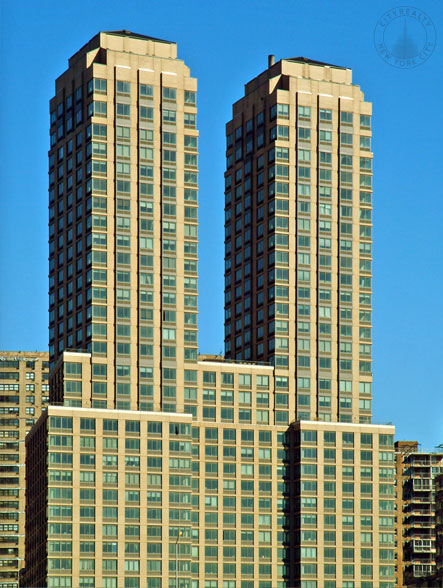
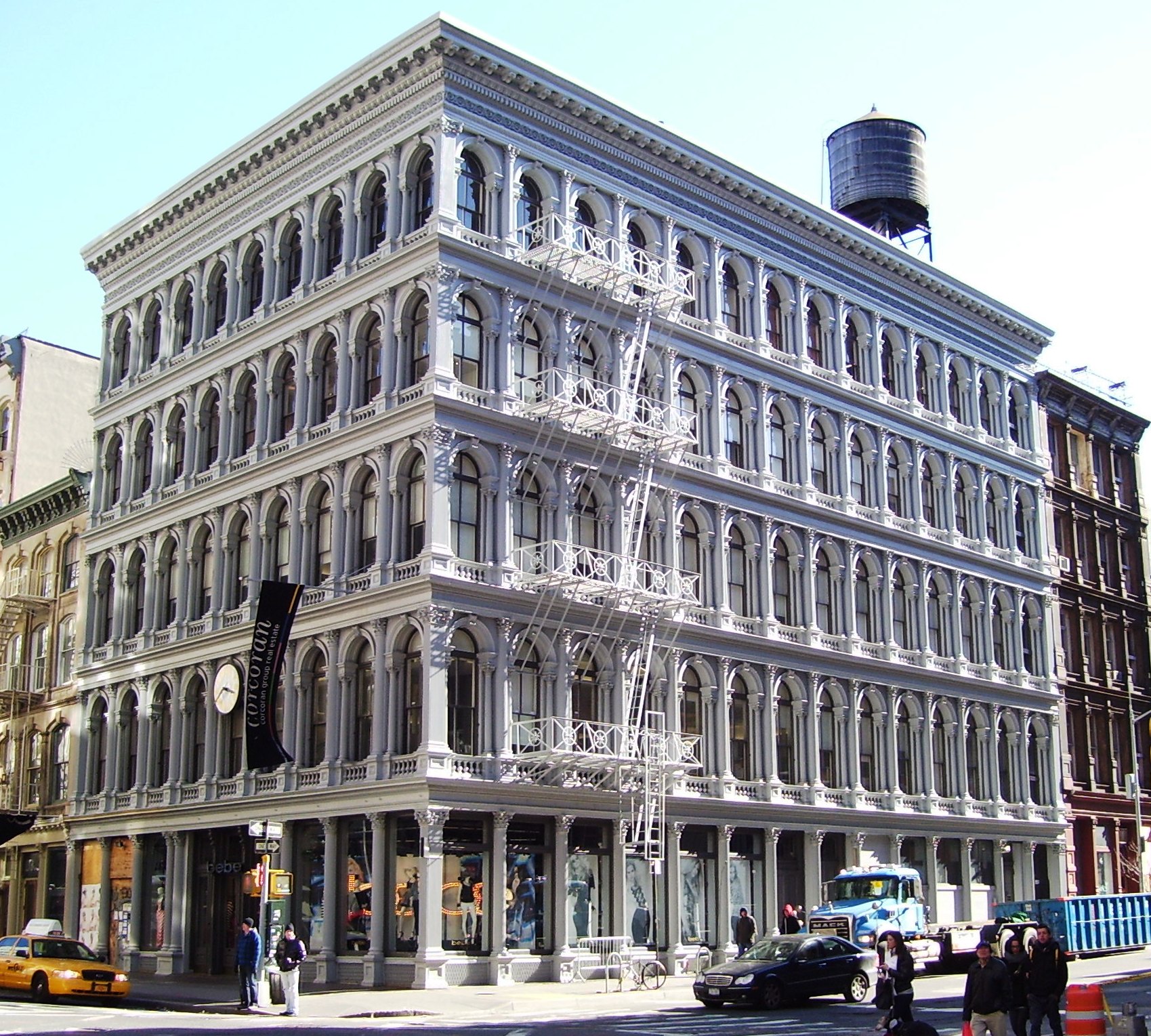
“…to walk enough stairs in a lifetime to climb the Empire State Building, and then climb it again: One-Thousand Times.”from this Centrum Silver commercial. Actor: Damien Leake, Voice-over by Martin Sheen.
Showing posts with label New York. Show all posts
Monday, March 17, 2014
Climb The Empire State Building 1,000 Times
Friday, March 14, 2014
The Anachronistic Quality of the Word Skyscraper
He went outside and crossed the avenue, then turned and faced the building where he lived. he felt contiguous with it. It was eighty-nine stories, a prime number, in an undistinguished sheath of hazy bronze glass. They shared an edge or boundary, skyscraper and man. It was nine hundred feet high, the tallest residential tower in the world, a commonplace oblong whose only statement was its size. It had the kind of banality that reveals itself over time as being truly brutal. He liked it for this reason. He liked to stand and look at it when he felt this way. He felt wary, drowsy and insubstantial.
The tower gave him strength and depth.
—Cosmopolis, by Don Delillo, 2003
Although the book doesn't name the building explicitly, the description of the world's tallest residential building, on First Avenue in Manhattan, means it can only be the Trump World Tower.
photos ©2011 Bauzeitgeist.
Monday, March 10, 2014
Jimmy Fallon's Skyline
A few weeks ago, the Tonight Show starring Jimmy Fallon made its big debut. I don't watch a lot of television, much less late at night, but think Jimmy Fallon is a really clever, energetic, creative entertainer, and nowadays its easy to watch a handful of clips on YouTube and feel like you're at least partly aware of what is going on.
The Tonight Show has an all-new set, which follows the standard desk-and-couches-on-a-soundstage format. What I immediately noticed was the backdrop, which is made up of a panoramic photo image of Mahattan, but in front of it what was especially notable is a collection of more than three dozen wood building models.
The buildings are arrayed randomly in the display—their arrangement doesn't correspond to their true relationships, and it doesn't appear as though the models are to scale with one another. This makes identification a bit difficult, and I am also not certain that all the models have been detailed with equal faith to their original appearance. There is a small, laser-cut Pan Am Building, visible second from left above; it is less-detailed and more diminutive than the finely detailed McKim frontage of the NYP Library and the Chrysler Building just over Jimmy's left shoulder, which seem to use a variety of materials and might even be from a model kit.
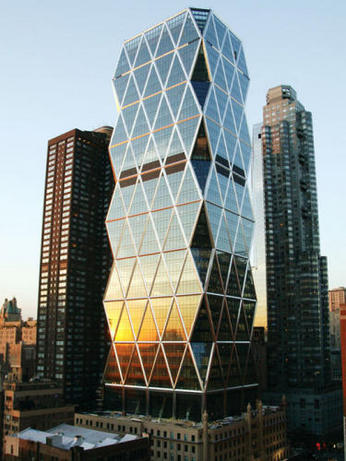
There are some interesting choices here, besides the world-famous landmarks such as old as the Woolworth and Chrysler Buildings and as new as the One World Trade Center, there are secondary icons like Johnson's AT&T Building, Stubbin's Citicorp Center and Johnson’s Lipstick building. Some other notable inclusions include Piano’s New York Times Building, just behind Jimmy, and at the far left, normally not visible but clearly shown in these scenes of U2 and Will Smith, Foster’s Hearst Tower. Other recognizable but far less identifiable towers include post-modern art deco Trump Riverside, the bland corporate mid-rise of 4 World Financial Center, and the hipster Maritime Hotel.
There is a foreground layer of low-rise landmarks, too, including the Arch in Washington Square Park, the Pier 17 at the South Street Seaport, the Guggenheim, New York Public Library, the New York Stock Exchange, and the tripartite arrangement of Lincoln Center.
But still, I was only confident in labelled a little more than half of them: is that the Daily News Building just over Jimmy's right shoulder? Is that big, French-Empire Style manse behind the guests, with its green-copper roof, supposed to be the legendary Dakota apartments? Others, like the sample Tribeca warehouse and the prototypical SoHo cast iron façade, would be laborious to pinpoint to a specific real-life building. For all I know, a third of the models are just made-up, and not based on real buildings. I certainly suspect that is the case, even with the larger models such as those between the Chrysler and Citicorp to Fallon's left, at the far right of the background.
When Jerry Seinfeld visited the new show, while praising the show, he turned around admired the elaborate background:
During Justin Timberlake's appearance, its easy to spot the AT&T Building, directly behind the microphone,
with what might be the Daily News Building behind.
The Woolworth Building is easy to spot behind Timberlake at far left.
I am tempted to suggest that the Building to its right, behind Timberlake's head,
is the Helmsley Park Lane Hotel on Central Park South.
The Chrysler Building shines behind Fallon's right shoulder, with the Lipstick Building in front.
Behind Fallon's left shoulder, in the shadows at far right, is Piano's New York Times HQ,
with a twin tower from Trump Riverside in front.
During U2's performance, 1 World Trade Center and the Hearst Tower are clearly seen behind the Edge.
Kristen Wiig impersonating Jason Styles. Lincoln Center is clearly visible at left,
with what appears to be a tiny Guggenheim Museum in front.
Behind Kristen Wiig, on her right: A SoHo building, Pier 17, the Dakota?
On her left: a TriBeCa warehouse, Lincoln Center at lower right, and the Maritime Hotel behind.
”I love the set. I love the rich kid NY chess set. This is the upper east side kid's chess set. It's beautiful, but I would move the chrysler building to king 4...”
Saturday, February 1, 2014
Säule, Schlucht, Erscheinung
Sixth Avenue at Rockefeller Center, looking south. ©1978 Blake Andrews.
NEW YORK, CHICAGO, DUBAI, FLORIDA, SAN FRANCISCO, TORONTO, SÃO PAULO, LOS ANGELES.
In the last post about Cleveland, I briefly mentioned in passing a unique urban phenomenon, the visual effect of rows of tall buildings arranged along a city street. I've noticed this for years, and mentioning it made me think about its varieties and ways to describe it. While I can't offer an academic analysis here, I'm going to try to briefly explore it a bit further.
While others may have long since recognized this phenomenon as well, I am not sure if this urban distinction has undergone appellation. It seems to be born out of uniquely American urban conditions: the downtown cores of classic large American cities, where tall buildings are arranged in orthogonal grids, the blocks equally spaced apart, filling up the envelope of each property in a uniform fashion, so that the fronts of each block align. The buildings not necessarily skyscrapers, but are sufficiently tall as to suggest a wall along either side of the street, as a hedge-row on a country lane, interrupted only by cross-streets. The buildings develop a conversational relationship with one another; each block becomes a component of a larger arrangement.
I. Säule and Zeile
Manhattan would be both the most recognized and recorded, but also the largest and most expressive example of this: the island's density stretching along its numbered avenues for six or seven miles in straight lines. It is one of the most quintessential aspects of Manhattan's appearance, although I am not sure it has ever been specifically given a name, although Manhattan's deep density of full-block buildings has been described as canyons of buildings, which partially describes the phenomenon.
But it is not limited to New York. Chicago’s Loop expresses this aspect as well, although Chicago's central business district, while quite large, is much smaller and less elongated than Manhattan. The Loop has a clear limit, giving way to warehouse districts and residential areas, whereas Manhattan's avenues vanish, and its cross-streets disappear into the waterfront. Visually, constructed canyons seem carved in each cardinal coordinate.
There are many other examples; as the effect momentarily occurs one street in a small downtown like Cleveland, there are probably countless individual examples in dozens of American cities with a sufficient building stock and suitably wide, straight streets, built up with adequately tall buildings—Washington and Paris are too low to the street to have the affect appear.
It would be possible to capture this atmosphere in large, grid-array downtowns in Vancouver or Houston, and perhaps Sydney or Melbourne—any place where a forest of skyscrapers is arranged across a rigid orthogonal street pattern, from Beijing to Buenos Aires. Maybe not so much London, Paris, Hong Kong or Kuala Lumpur, but here and there in Johannesburg, perhaps the Ginza ward of Tokyo.
São Paulo expresses it at least on the mammoth Avenida Paulista, if not elsewhere in its vast forest of high-rise buildings, although the city does not have strict grid system. An interesting detail of Avenida Paulista is the pyramidal Edificio FIESP, photogenic for breaking up the slab-wall affect the regularly-intervaled façades.
A near-appearance of the phenomenon on Commissioner's Street in Johannesburg.
It would be possible to capture this atmosphere in large, grid-array downtowns in Vancouver or Houston, and perhaps Sydney or Melbourne—any place where a forest of skyscrapers is arranged across a rigid orthogonal street pattern, from Beijing to Buenos Aires. Maybe not so much London, Paris, Hong Kong or Kuala Lumpur, but here and there in Johannesburg, perhaps the Ginza ward of Tokyo.
Avenida Paulista, from Wikipedia.
Photo of Avenida Paulista and the FIESP Building, by Panoramio user Rmartinipoa.
Downtown San Francisco's financial district somewhat weakly presents this phenomenon, with the added effect of the canyon floor sweeping up the steep hillsides at the far end of each street, or looking out towards the Bay, aligning with the span of the Bay Bridge.
The Streets of San Francisco.
II. Schlange-Schlucht
More linear than the mile-long boulevards of Manhattan are places where dense clusters of high-value real estate are divided into roughly equal sites, but the conditions only yield a single row of high-rise buildings. This is a typically littoral condition: it recalls the heavily urbanized coast of Southern Florida, for example, and other locations where high-rise towers, mostly residential or hotels, march along a main street that follows the coastline, like Cancún. However, in the case of typically-curvacious resort-style architecture, there is not enough alignment for the full effect to register.
The near-effect seen in Sunny Isles, Florida. ©2014 Bauzeitgeist.
The most distinct difference between this linear row and that of an American downtown is that the arrangement is only one block wide on either side. While not necessarily evident from a straight-on perspective down this one street, the edges of vision, and the visual understanding of the wider urban area, imply that the density discontinues after only one row of buildings.
The best example of this that I know of is Sheikh Zayed Road in Dubai, which is both long, wide, and evenly spaced with high rises, some extremely tall, columns on either side. Although Dubai is a littoral city, Sheikh Zayed Road itself is away from the beachfront, and the single rows of skyscrapers stand with low-rise buildings behind, or nothing but dry lots of open desert. Dubai's mid-town does not spread across a gridded district of regular built density, but stretches on either side of a single major street.
Images of Sheikh Zayed Road in Dubai from Wikipedia and FlashyDubai.com.
III. Hyper-Schlange Schlucht Straße
Related to the narrow hedge-row effect of Sheikh Zayed Road, a third variety of this phenomenon emphasizes the appearance of tall buildings fronting a significant thoroughfare in an otherwise low-rise environment, often in the case where a major street connects multiple centers of a sprawling metropolis. While the façade-wall effect is visible along the prospect itself, it is no longer set out along a grid of blocks. The hedge-row effect is more clearly understood from above, where the contrast in height is more evident.
Mid-Wilshire, Los Angeles.
The two large examples that come to mind are Wilshire Boulevard in Los Angeles and Yonge Street in Toronto.
If sprawling Los Angeles has a Broadway, it is Wilshire, which curves at several points along the low foothills as it stretches more than a dozen miles, from downtown Los Angeles through affluent West L.A. towards the Pacific Ocean, terminating in Santa Monica. L.A. is perhaps too famous for it’s sprawl, when it really a city of average density, and Wilshire provides one of it’s most distinct urban moments.
Whether by accident of real estate value or determined more didactically by zoning, either side of this thoroughfare is lined with mostly rectangular office blocks, passing through various clusters and campuses of high-rises at downtown LA and Century City, but otherwise distinct from the low-rise and often residential neighborhoods beyond the rows of columns. As with Sheikh Zayed Road, the contrast is most distinct from the air.
Toronto looking north from the CN Tower ©2011 Bauzeitgeist.
Labels:
Chicago,
Dubai,
Florida,
Johannseburg,
Los Angeles,
New York,
San Francisco,
Sao Paulo,
Stadtkrone-Untersuchung,
Toronto,
Vancouver
Saturday, September 1, 2012
Austellung: Das Architekturmodell: Werkzeug, Fetisch, Kleine Utopie
FRANKFURT.
There are less than two weeks left to see what I think might be the most marvelous and wonderful exhibit that I've seen in several years: The Architectural Model: Tool, Fetish, Small Utopia at the Deutsches Architekturmuseum in Frankfurt. This fantastic show closes on 16 September.
One measure of how outstanding this show is would be to report that I left a Mediterranean beach a day early in mid-August, flew to Germany and spent the night, and the show was worth missing out on another day in the ocean and the substantial extra expense of making a dedicated trip to Frankfurt.
A mid-century German children's toy of a bank block.
A delightful series of peep-holes offered views into built and unbuilt worlds
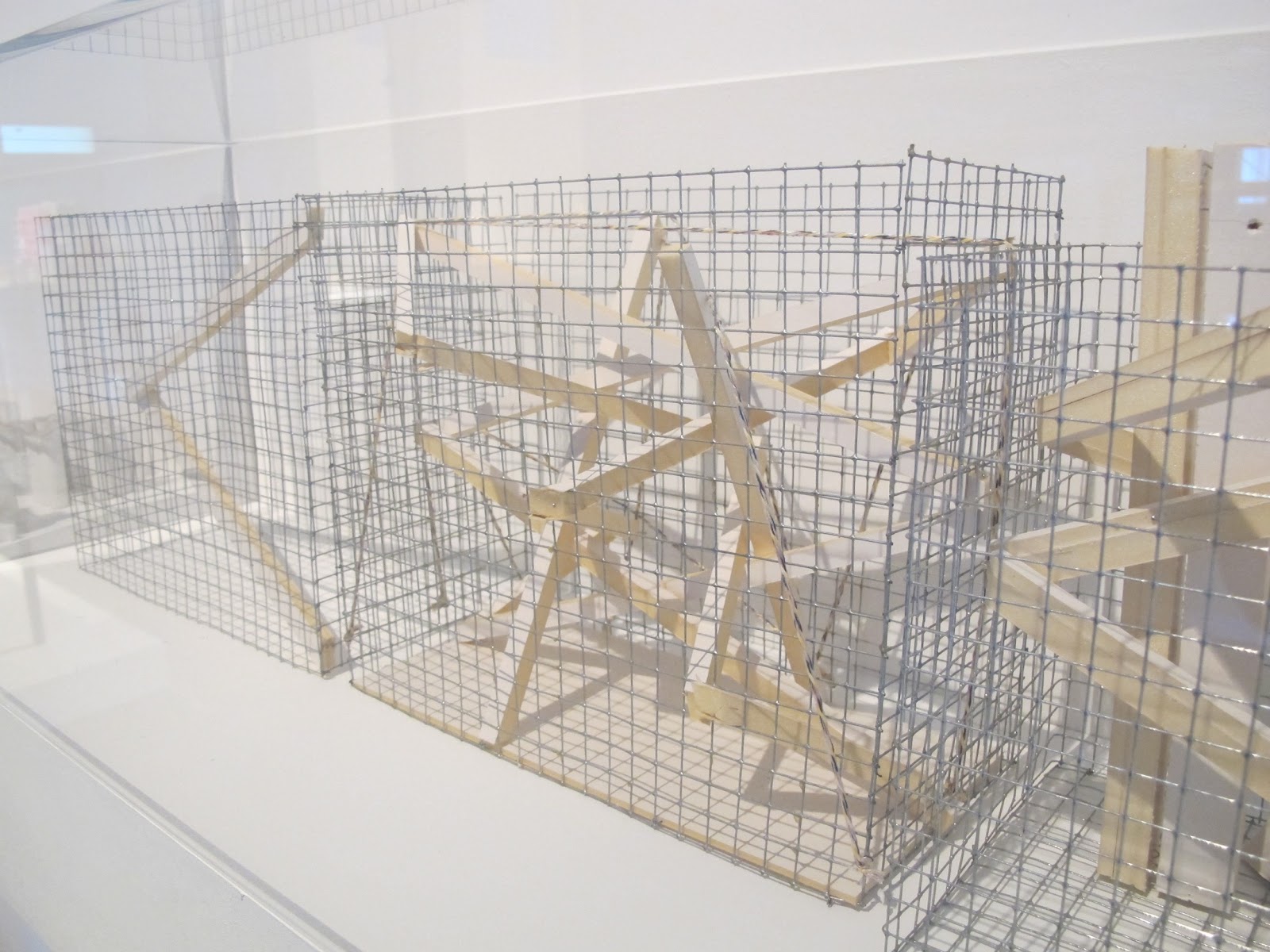
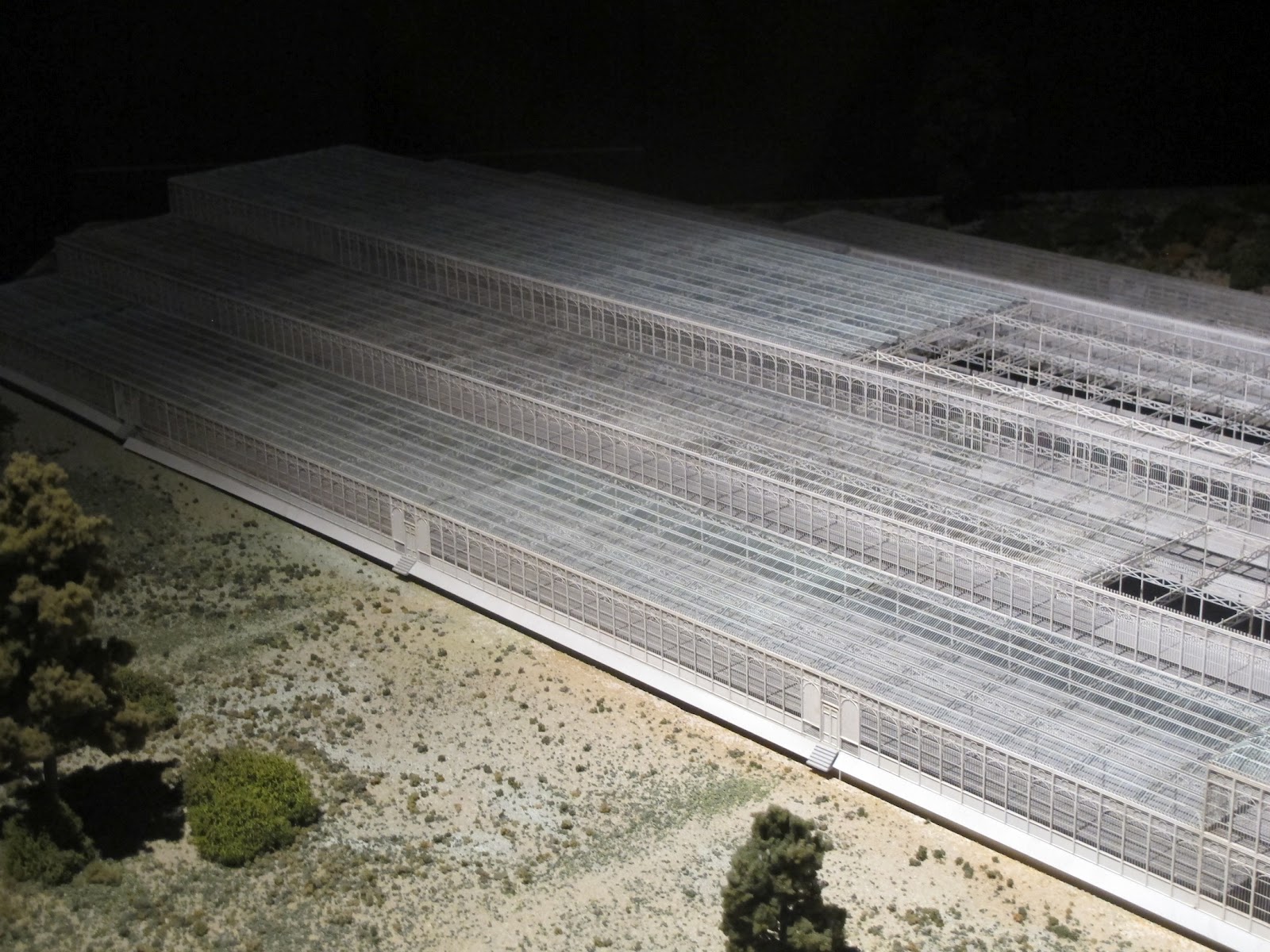
Another demonstration of the show's merits is to show here three-dozen or so images from the exhibit, which takes up three floors of the German Architectural Museum with a plethora of astonishing, inspiring, and simply gorgeous architectural models, from children's toys to presentation models, iterative study models to vast recreations of ancient monuments, rare proposals of never-built masterpieces, peep-hole views into far-off rooms and staggeringly detailed, person-sized skyscrapers.
Conrad Roland's drawing for an exhibition hall with floating levels, 1964
Conrad Roland's Spiralhochhaus, which incredibly was conceived in 1963.
Still mesmerizing: the original model for
Frei Otto's Medizinsche Fakultät Ulm, 1965.
Wolfgang Rathke's German Pavilion for the
Worlds Fair in Montreal, 1964-65, mode of pink straws.
Christian Kerez's unbuilt Swiss Re Headquarters in Zürich.
Detail of the table-size model of Arata Isozaki's Cluster in the Air, 1962
One of the more striking models in the whole exhibit:
Emilio Ambasz's design for the Center for Applied Computer Research,
Mexico City,1974-75
James Stirling's Churchill College proposal, Apr-May 1959
While these never-to-be environments, found on both the ground floor and the top, would alone make for a noteworthy exhibit, the second floor is particularly awesome: At model-railroad scales (most 1:200), the visitor can play bird, or god, hovering over the humungous dioramas of ancient, medieval, and modern landscapes, many of which turned to dust centuries before the helicopter. The room opens with the quintessential rotorcraft view: a frenetic five-block slice of mid-town Manhattan, bustling with taxis at the foot of the Pan Am Building and bending around Grand Central Station.
The Royal Crescent, Bath.
A busy day in central Pompeii
The acropolis at Mycenae
Temple of the Pharaohs, Dêr El Bahari, Egypt.
Bruchfeldstraße Housing Development, Frankfurt-Niederrad, 1926-27
The Baroque town of Arolsen, North Hesse as it appeared in 1719
An unfortunate moment of sorts occurs as the visitor returns to the stairwell: the last diorama shows an Orinocoan settlement, a ring-clearing in the forest constructed by the indigenous Yanoama culture, one of the few moments of non-Indo-European architecture in the whole exhibit. Having seen these mono-structural villages in anthropological texts, I can attest to their impressive monumentality imbued with spiritual reasoning, which juxtaposes quite well with the square of Pompeii nearby and the Valley of Egypt across the room.
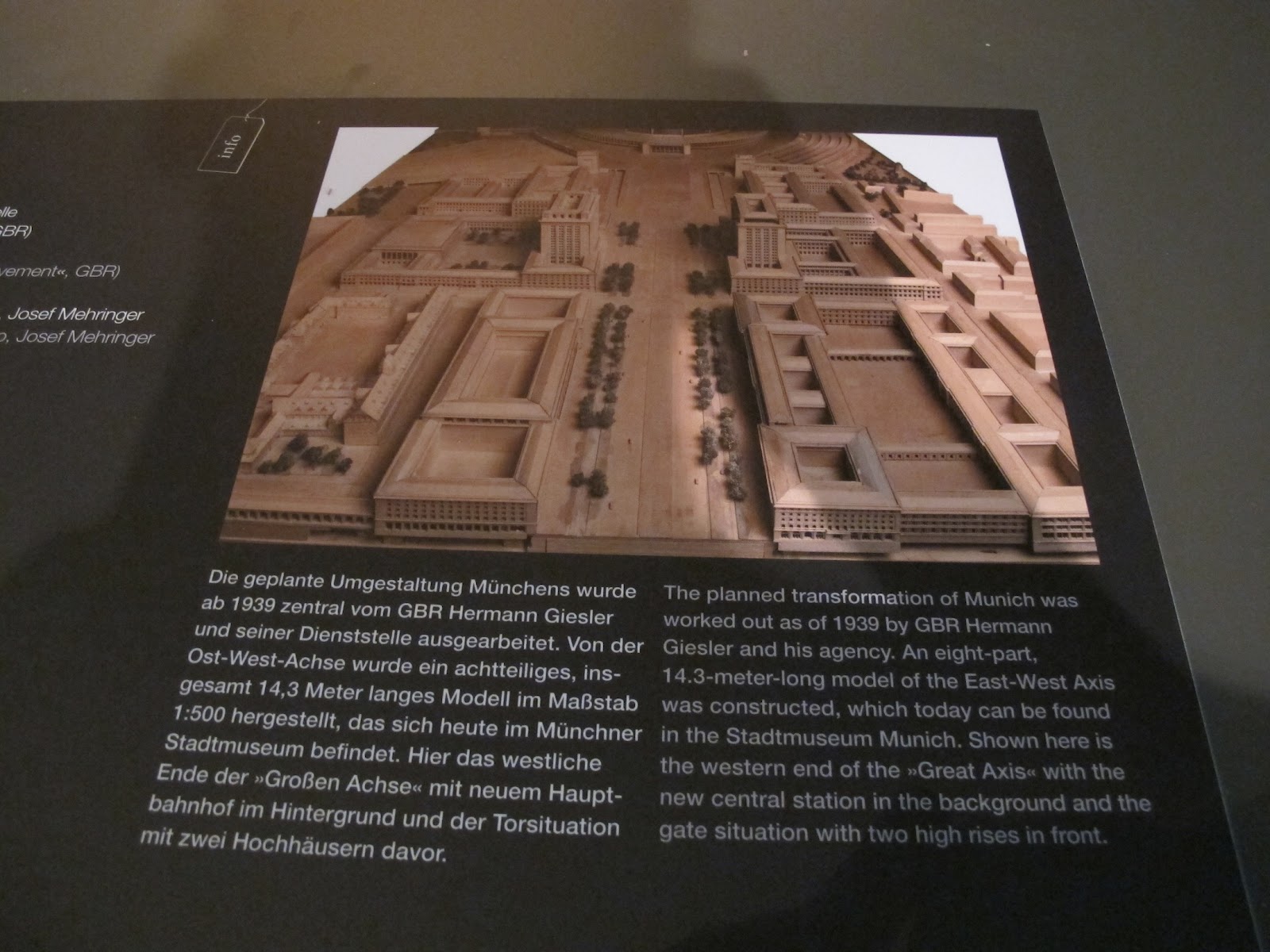
Yet the accompanying wall panel merely assigns the Yanoama the word, "primitive" which is at best a thoughtless translation, and at worst a very unenlightened classification system for a German institution to be using to categorize various peoples of the world. The more ignominious connotations of this moment are ameliorated by the floor above, which give over ample space to the importance of models in Hitler's Reich, with photos, texts, and objects from the office of Albert Speer, and the like.
The village center, a clearing the rainforest, ringed by dwellings,
signature construction of the Yanoama,
and how these "Indians" are described on the wall label.
A placard explaining the fascist plan for Munich, 1939.
While there is plenty of text for student or professional visitors, cueing into process, explanations of formal evolution, struggling with formal idea to execution, the constraints of construction, material, and reality, these aspects can become a bit heavy and technical, especially for those viewers who associate foam and plywood with late nights in the studio. With such a large exhibit, the great number of items to view is itself overwhelming. The exhibit might be most enjoyable in the unfamiliar moments of a micro-vista or a lilliputian skyline, understanding its translation to scale and contemplating the possibilities it suggests. These are sensations of another world.
A stunning series of small foam creations.
It is a simple matter of a 15-minute walk from the museum, crossing the Main on foot to see this architectural moment in person. While the model's white foam pieces come alive in brick, stone and glass in the sunlight, the dynamic might of the tower's mass against the block and older offices is somehow lessened from the street. Yet this arrangement of masses is more familiar now. Having looked down, it is better understood. For a moment, you flew above it, and could hold a tower in your hand. But you are no longer flying. The imaginary helicopter has landed back on earth, in reality.
Labels:
Archaeology,
Austellung,
Erfundenstadt,
Frankfurt,
Frei Otto,
James Stirling,
London,
Mesoamerika,
Metabolism,
Montreal,
New York,
Norman Foster,
Pan Am Building,
Ulm,
Vogelperspective
Subscribe to:
Posts (Atom)