Showing posts with label Stubbins. Show all posts

Monday, March 10, 2014

Jimmy Fallon's Skyline

A few weeks ago, the Tonight Show starring Jimmy Fallon made its big debut. I don't watch a lot of television, much less late at night, but think Jimmy Fallon is a really clever, energetic, creative entertainer, and nowadays its easy to watch a handful of clips on YouTube and feel like you're at least partly aware of what is going on.


The Tonight Show has an all-new set, which follows the standard desk-and-couches-on-a-soundstage format. What I immediately noticed was the backdrop, which is made up of a panoramic photo image of Mahattan, but in front of it what was especially notable is a collection of more than three dozen wood building models.


The buildings are arrayed randomly in the display—their arrangement doesn't correspond to their true relationships, and it doesn't appear as though the models are to scale with one another. This makes identification a bit difficult, and I am also not certain that all the models have been detailed with equal faith to their original appearance. There is a small, laser-cut Pan Am Building, visible second from left above; it is less-detailed and more diminutive than the finely detailed McKim frontage of the NYP Library and the Chrysler Building just over Jimmy's left shoulder, which seem to use a variety of materials and might even be from a model kit.

During Justin Timberlake's appearance, its easy to spot the AT&T Building, directly behind the microphone, 
with what might be the Daily News Building behind. 
The Woolworth Building is easy to spot behind Timberlake at far left. 
I am tempted to suggest that the Building to its right, behind Timberlake's head, 


is the Helmsley Park Lane Hotel on Central Park South.

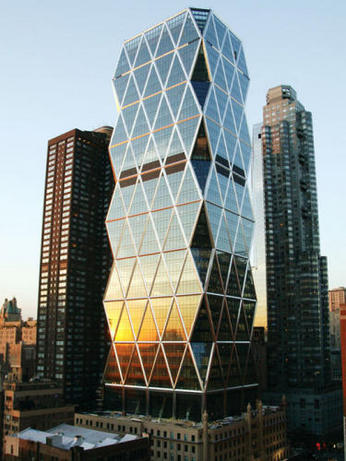
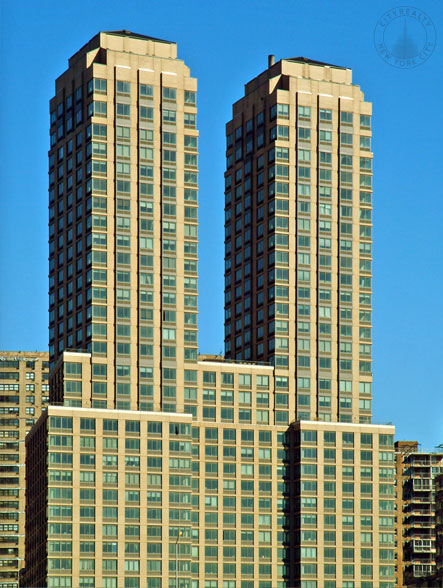
There are some interesting choices here, besides the world-famous landmarks such as old as the Woolworth and Chrysler Buildings and as new as the One World Trade Center, there are secondary icons like Johnson's AT&T Building, Stubbin's Citicorp Center and Johnson’s Lipstick building. Some other notable inclusions include Piano’s New York Times Building, just behind Jimmy, and at the far left, normally not visible but clearly shown in these scenes of U2 and Will Smith, Foster’s Hearst Tower. Other recognizable but far less identifiable towers include post-modern art deco Trump Riverside, the bland corporate mid-rise of 4 World Financial Center, and the hipster Maritime Hotel.

The Chrysler Building shines behind Fallon's right shoulder, with the Lipstick Building in front. 
Behind Fallon's left shoulder, in the shadows at far right, is Piano's New York Times HQ, 
with a twin tower from Trump Riverside in front. 

There is a foreground layer of low-rise landmarks, too, including the Arch in Washington Square Park, the Pier 17 at the South Street Seaport, the Guggenheim, New York Public Library, the New York Stock Exchange, and the tripartite arrangement of Lincoln Center.


During U2's performance, 1 World Trade Center and the Hearst Tower are clearly seen behind the Edge. 

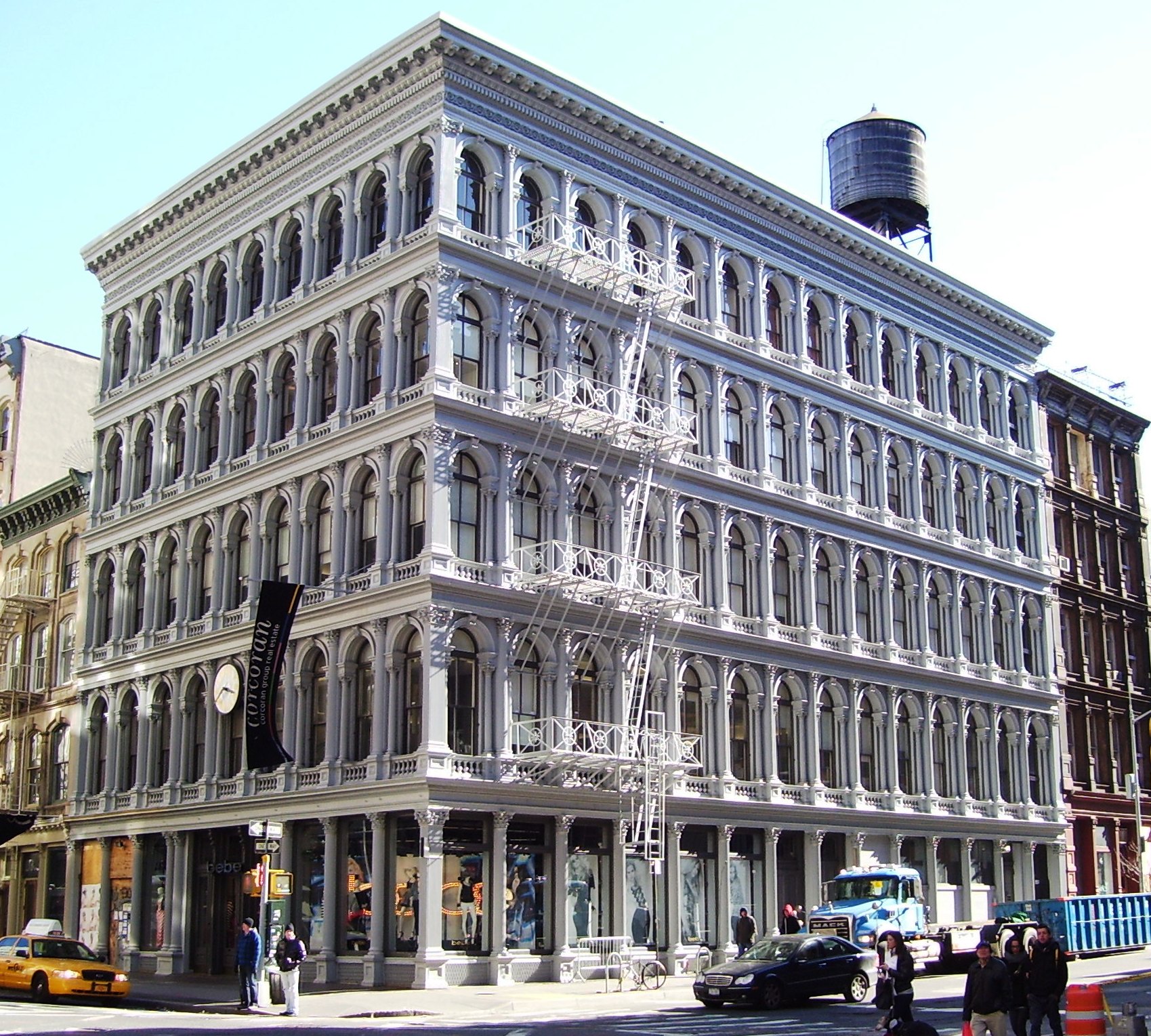
But still, I was only confident in labelled a little more than half of them: is that the Daily News Building just over Jimmy's right shoulder? Is that big, French-Empire Style manse behind the guests, with its green-copper roof, supposed to be the legendary Dakota apartments? Others, like the sample Tribeca warehouse and the prototypical SoHo cast iron façade, would be laborious to pinpoint to a specific real-life building. For all I know, a third of the models are just made-up, and not based on real buildings. I certainly suspect that is the case, even with the larger models such as those between the Chrysler and Citicorp to Fallon's left, at the far right of the background.

Kristen Wiig impersonating Jason Styles. Lincoln Center is clearly visible at left, 
with what appears to be a tiny Guggenheim Museum in front. 

Behind Kristen Wiig, on her right: A SoHo building, Pier 17, the Dakota? 
On her left: a TriBeCa warehouse, Lincoln Center at lower right, and the Maritime Hotel behind.

When Jerry Seinfeld visited the new show, while praising the show, he turned around admired the elaborate background:

”I love the set. I love the rich kid NY chess set. This is the upper east side kid's chess set. It's beautiful, but I would move the chrysler building to king 4...”


Here is a quick diagram I made of the display, with whatever buildings I could identify. Suggestions for changes or additions are welcome in the comments section: 


Monday, May 30, 2011

Amerikanischen Stadtkrönen


BOSTON, NEWARK, BALTIMORE, CHICAGO, SAN FRANCISCO, PITTSBURGH, RALEIGH, CHARLOTTE.

The waiting room of Boston's South Station is a soaring volume, like a high school gymnasium, It is currently made more so, as at present it is adorned with a group of enormous fabric advertising banners, hanging from the ceiling girders, like varsity championship pennants. The adverts were for JetBlue Airways, informing the rail-riding public of all the cities that JetBlue serves non-stop from Boston Logan Airport, which sits a few miles across the harbor from the train station.

Perhaps railway passengers should not, in this age of carbon footprints, be encouraged to travel to Baltimore or Newark by airplane instead of rail at all. Separately, the artistic talent evinced by the banners' graphic design, which seems could be accomplished by an Adobe Illustrator novice in a few minutes, do not deserve much merit in a purely aesthetic sense. However, the ads are interesting in the way represent their subjects, and what this suggests about American cities and their architectural identities.


In this series, multicolored simulacra skylines stand in for the cities of Baltimore, Charlotte, Chicago, Newark, Pittsburgh, Raleigh and San Francisco. Some of these cities are undeniably better-known than others. Non-Americans might not even really know where Charlotte or Raleigh are (both in North Carolina)--which might cause some mutual surprise, given their size and economic might. Several of these cities do not make the top of the list of destinations for either Americans or foreigners, so as advertising subjects they are unusual, and further it is curious to consider the artistic choices made in their simulation.


Two of them, San Francisco and Chicago, are both celebrated as among America's most beautiful, historic, thriving, celebrated metropolitan centers, and also are home to what are arguably some of the country's most recognizable skyscrapers. San Francisco is home to the unique Transamerica Pyramid, an icon of that city. Chicago is home to many well-known tall buildings, but there another pyramidal form, the John Hancock Tower is widely recognized as a symbol of that great metropolis.


The Chicago poster may be my favorite of the lot. It conveys a portion of the Chicago's enormous skyline at a wonderful, theatrical moment in the northern approach down Lake Shore Drive, when that parkway aligns with Michigan Avenue's Magnificent Mile, marking the beginning of the city center. This humungous entry gate is anchored by several tall buildings, three of which are shown here: the John Hancock Building and the Four Seasons Hotel, with its quad-anchor of faux lanterns on top, and the art deco Playboy/Colgate-Palmolive Building.
Prior the the Hancock's construction, the Playboy building dominated this south-facing perspective of the city center. Originally the headquarters for the Palmolive multinational, the building was refurbished in 2006-2008 into a luxurious condominium tower.


©2007 Bauzeitgeist.

Probably the most well-known icon of all the buildings represented in the JetBlue ad series, the Transamerica Pyramid dominates the representation of San Francisco. The artist has given some more detail to the composition, pairing the pyramid with the unique outline of the Mandarin Oriental Hotel, its multileveled guest room wings connected by a translucent spine of glass sky lobbies, its roof capped by decorative masts, giving the whole block a futuristic, insect-like form. Thirdly, the much shorter Embarcadero Center West makes an appearance at the bottom left in orange.

image of San Francisco courtesy of Flickr user m.john16 2007.
Mandarin Oriental and Embarcadero Center West can be seen at left.

Charlotte's visage shows the Bank of America and Duke Energy Headquarters buildings. BoA's tower was one several shiny, paramount regional banking headquarter towers that Cesar Pelli completed in the 1990s in the United States, and in both use, appearance and compositional participation is strikingly similar to his Key Bank Tower in Cleveland.


image of Charlotte courtesy of Flickr user Willamor Media

Raleigh is another North Carolina late-20th century service-industry boomtown. The tallest office building is named for BB&T Bank Building (Officially, 2 Hannover Square) and was built in 1991. At left, the Royal Bank of Canada Plaza, which was completed in 2008, includes several floors of condominiums and is capped by a small steeple.


top image of Raleigh courtesy of Flickr user twbuckner2009

Its not entirely clear, but it seems that the Newark poster is meant to feature the skyline Jersey City, which was built up in the last few decades in the waves of decentralization of Wall Street, and thus serves as a Manhattan version of the Isle of Dogs.


These low-rise triangles are intended to be the Baltimore Harbor aquarium, the anchor to the urban renewal project of twenty years ago, which transformed the waterfront into a tourism center, a feat which spawned imitation downtown acquaria and boutique retro-ballpark districts throughout the United States and elsewhere.


image of Baltimore courtesy Flickr user Nemeers12010

Pittsburgh's advertisement, though spare, successfully conveys the unique, romantic affinity that so many of its residents and former residents hold for it. It shows one of its yellow river bridges, as well as the "Fifth Avenue Place" building, twenty years on from its erection in the postmodern ebullience (pink granite from Spain, accent granite from Finland) of that brief rust belt renaissance of the mid-1990s. Today its lobby is a tired, half-empty shopping arcade.

The other element in the banner is presumably the old US Steel Building, built in the 1970s as a symbol of America's corporate-industrial might, and still Pittsburgh's tallest building. Its kind of an impressive edifice, especially up close.


image of Pittsburgh courtesy Flickr user peapunk6

Aside from the Skyscraper Page crowd, it would perhaps be a challenge for many to identify these cities based on their skylines alone, much less these 5-minute Adobe Illustrator cartoons of each. Perhaps even residents of these cities wouldn't recognize a drawing derivating from the regional bank tower or luxury hotel high-rise which looms over their metropole. Generically, how many Pennsylvanians would see this and say, 'oh yes, there's old Pittsburgh, and they got the bridge right, too...'

More directly, in terms of its commercial persuasion, I wonder how many in its audience glance up and are convinced by those semi-opaque rectangles to fly to New Jersey. How many erstwhile denizens of Raleigh would see this ad and exclaim "How I long to see the RBC building in real life…that to me is home!"

unless otherwise noted, all images ©2011 Bauzeitgeist.

Friday, December 10, 2010

Four Seasons Federal Reserve Bank Boston Bahrain Bay


BOSTON, and BAHRAIN.

The rendering below shows a design divergent from the recent generation of flowy, melty, rendery, deconstructed designs that have been proposed for Gulf cities. Which is basically to say that its extremely rectilinear, as opposed to a form dictated by the transdimensional gymnastics of computer design programs.


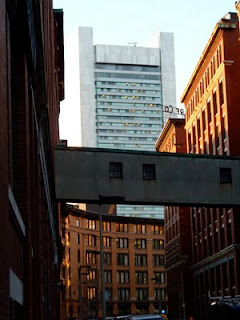
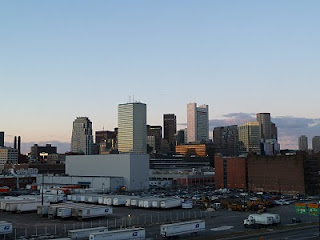
It is also unmistakably similar to one of Boston's more recognizable skyscrapers, the Federal Reserve Bank of Boston, built in and designed by Hugh Stubbins.


This second set of illustrations, via the website Daily Icon, are even more remarkable. Compare (the Four Seasons renderings are the images with the purple sky and palm trees):


When I was younger I was a big fan of Hugh Stubbins big, shiny, beaming skyscrapers: Citicorp, Cleveland Place, Yokohama, etc. More as elements of the skyline than buildings themselves.


The Federal Reserve is criticized for being suburban at its base, which is I presume a result of Fort Knox requirements, which is probably insufficient today.


©2005-2010 Bauzeitgeist, except renderings.

Nowadays I would be scoffed at for bringing Stubbins up as an example of great architecture. Which in a way makes it that much curiouser, then, that his design is being riffed in 2010 by SOM.